
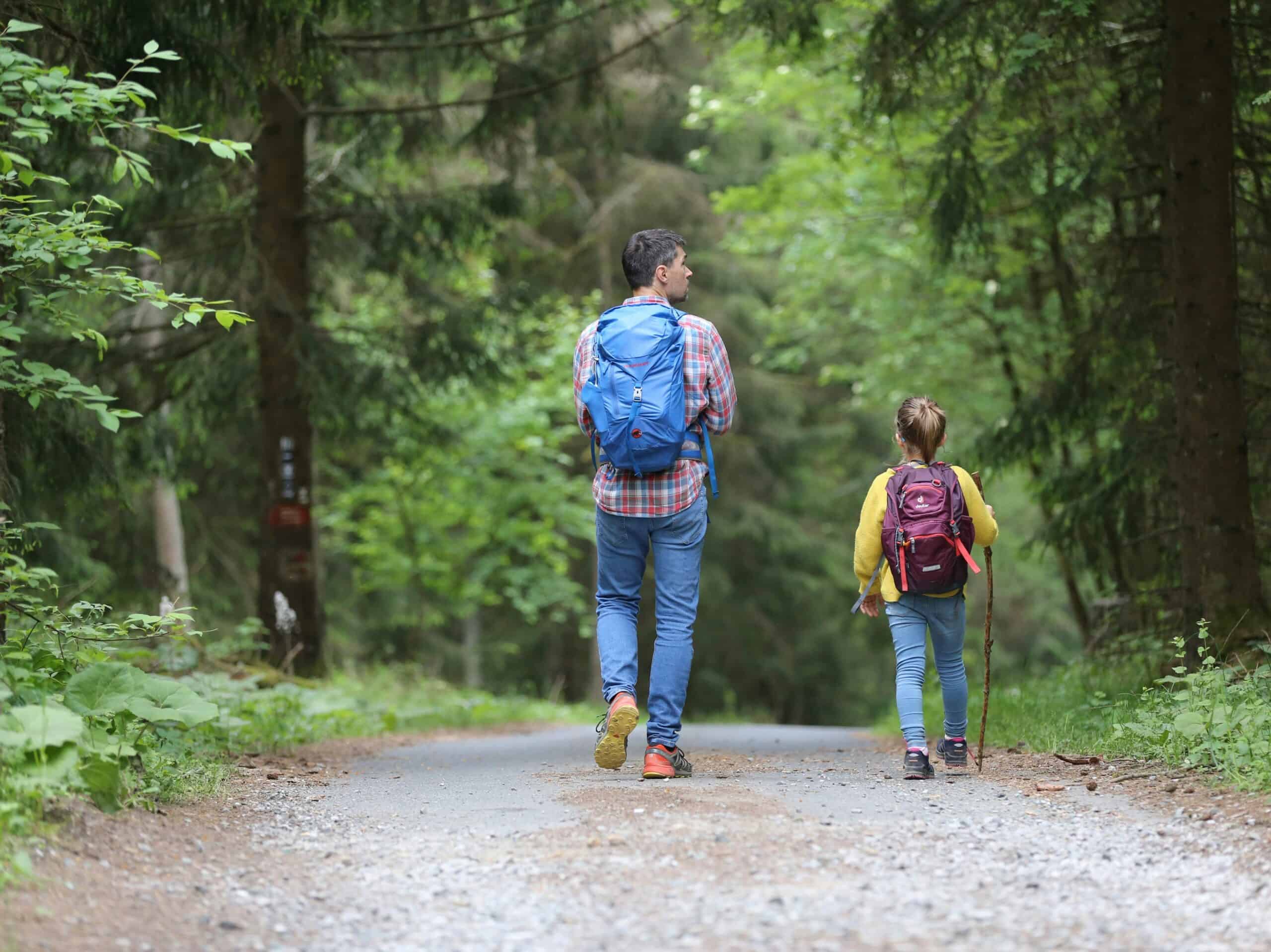
Hiking with children fails for predictable reasons, and distance is rarely one of them. It fails because the day was planned around covering ground when it needed to be planned around keeping them interested.
This covers realistic expectations, what to bring, and how to structure a day that works. Our guide on planning a hiking route covers the groundwork.
Quick Answer
Plan around interest rather than mileage, expect a pace far slower than your own, stop often, and choose destinations with something at them. Let children set the rhythm where you can, bring more food than seems reasonable, and treat turning back early as a success rather than a failure. Dogs need their own version of the same planning, and our guide on hiking with a dog covers distance, heat and paw checks.
Key Points
- Distance matters far less than what is along the way.
- Pace is unpredictable rather than simply slow.
- Snacks and stops prevent most problems.
- A destination gives the walk a point.
- Ending early keeps them wanting to come back.
What Changes With Children
| Factor | How it differs |
|---|---|
| Pace | Variable, not just slower |
| Motivation | Needs a reason beyond the walk |
| Temperature | Children regulate differently |
| Food | Needed more often, in smaller amounts |
| Attention | Interest drives everything |
| Turning back | Should be planned for, not resisted |
Plan Around Interest, Not Distance
The single most useful shift is measuring a hike by what is on it rather than how far it goes.
A mile with a creek, boulders to climb and a lake at the end works better than three miles of pleasant but uniform trail.
Children stop for things adults walk past, and treating those stops as the point rather than as delay changes the whole day.
A destination helps enormously, since walking toward something concrete is easier to sustain than walking for its own sake.
Route choice matters more than fitness at almost every age. Our roundup of hiking daypacks covers carrying what a family day needs.
What Keeps Them Going
Frequent snacks throughout
Smaller portions and more often than adults need.
A destination that is worth reaching
Water, a view, or a rock worth climbing.
Letting them lead the way
Being at the front of the group changes everything.
Stopping before they actually need to
Recovery is always faster than repair.
Pace Is Variable, Not Just Slow
The mistake most people make is assuming children move at a steady slower speed, when the reality is bursts and stops.
They will run ahead on an interesting stretch and stop dead on a dull one, and averaging that into a planned pace produces a number that describes nothing.
Building large time buffers is more useful than estimating a pace, since the variance matters more than the average.
Uphill is where enthusiasm typically fails, and breaking a climb into visible sections helps more than encouragement does.
Descents bring their own problem, since tired children on loose ground fall more. Our hiking time and pace calculator is worth treating as a floor rather than an estimate here.
Food, Water and Temperature
Most trailside meltdowns trace to being hungry, thirsty, too hot or too cold, and all four are preventable.
Children need food more frequently than adults and in smaller amounts, so a steady supply of snacks works better than a single lunch stop.
Thirst is easy to miss when a child is absorbed in something, which makes offering water on a schedule more reliable than waiting for a request.
Temperature regulation differs by age, and younger children in particular can get cold quickly when they stop moving after being warm.
Carrying an extra layer that seems unnecessary is worth the space. Our roundup of hiking snacks covers what travels well.
Age Changes What Works
The same approach does not fit a toddler and a twelve year old, and the differences are larger than pace.
Very young children are carried for most of a hike, which shifts the constraint to the adult carrying them and to how long a small child tolerates being in a carrier. Our kids hiking gear guide covers what to put them in.
Early walking years bring enormous variability, where a child covers a surprising distance one day and refuses at the trailhead the next, and that is normal rather than a problem to solve.
Older children can genuinely hike, and at that point the limiting factor becomes interest rather than capability.
Teenagers frequently outpace the adults and lose interest for entirely different reasons, which usually respond to being given real responsibility on the trip.
Weather Matters More
Conditions that an adult finds mildly unpleasant can end a day with children entirely.
Rain is the clearest case. Adults push through it, children generally will not, and a wet child gets cold considerably faster than a wet adult.
Heat is harder to spot, since children absorbed in something do not always notice or mention it until they are genuinely uncomfortable.
Wind bothers children more than the temperature alone suggests, particularly on exposed ground where there is no relief.
Checking the forecast and being willing to postpone is more useful with children than with any other group. Our note on what to do when a storm hits covers the worse case.
Let Them Carry Something
A small pack of their own changes how children relate to the day, and the contents matter less than the fact of it.
Their own snacks and water is the usual starting point, kept light enough that it stays fun rather than becoming a burden.
The pack becoming a problem is a signal that it is too heavy or the day has gone on too long, and taking it without comment is better than a negotiation.
Older children can carry meaningfully more and frequently want to, particularly if it comes with being trusted to lead.
Involvement in choosing the route beforehand does something similar. Our guide on packing a backpack covers loading properly.
Ending Early Is a Success
The goal of a hike with children is not the summit. It is that they want to go again.
Turning back before anyone is miserable is what produces that, and pushing to a destination through complaints achieves the opposite.
This is worth deciding in advance, since the temptation to continue is strongest when you are closest and everyone is most tired.
A shorter hike that ended well builds toward longer ones far more reliably than a long one that ended badly.
Nobody remembers the mileage. Our turnaround time calculator covers fixing that limit before you leave.
Common Mistakes to Avoid
Planning the day by distance
A short trail with things on it beats a long uniform one. Interest determines what works, not mileage.
Assuming a steady slower pace
Children move in bursts and stops. Build time buffers rather than estimating an average.
Waiting for them to ask for food or water
Offering on a schedule prevents most problems. Asking usually comes too late.
Pushing on to the destination anyway
Turning back before anyone is miserable is what makes them want to come again.
Recommended Reading
See our roundup of hiking boots for beginners, our roundup of hiking socks, our note on what to do if you get lost, and our roundup of headlamps.
Hiking With Kids FAQ
How far can children actually hike?
It varies enormously with age, temperament and interest, and the trail itself matters more than the number. A short interesting route beats a long dull one at any age.
How do I keep them motivated?
A destination worth reaching, frequent snacks, and letting them lead. Walking toward something concrete sustains better than walking for its own sake.
Should they carry a pack?
A light one with their own snacks and water works well. Keep it light enough that it stays fun.
How often should we stop?
More often than feels necessary, and before anyone needs it. Recovery is quicker than repair.
What causes the most problems out there?
Hunger, thirst, and being too hot or too cold. All four are preventable with a schedule rather than a response.
What if they want to turn back?
Turn back. A hike that ended well builds toward longer ones far better than one that ended badly.
How do I estimate timing?
Build large buffers rather than estimating a pace, since children move in bursts and stops rather than steadily.
What is the most useful thing to bring?
More snacks than seems reasonable, and a spare layer. Both solve problems before they become the end of the day.
