
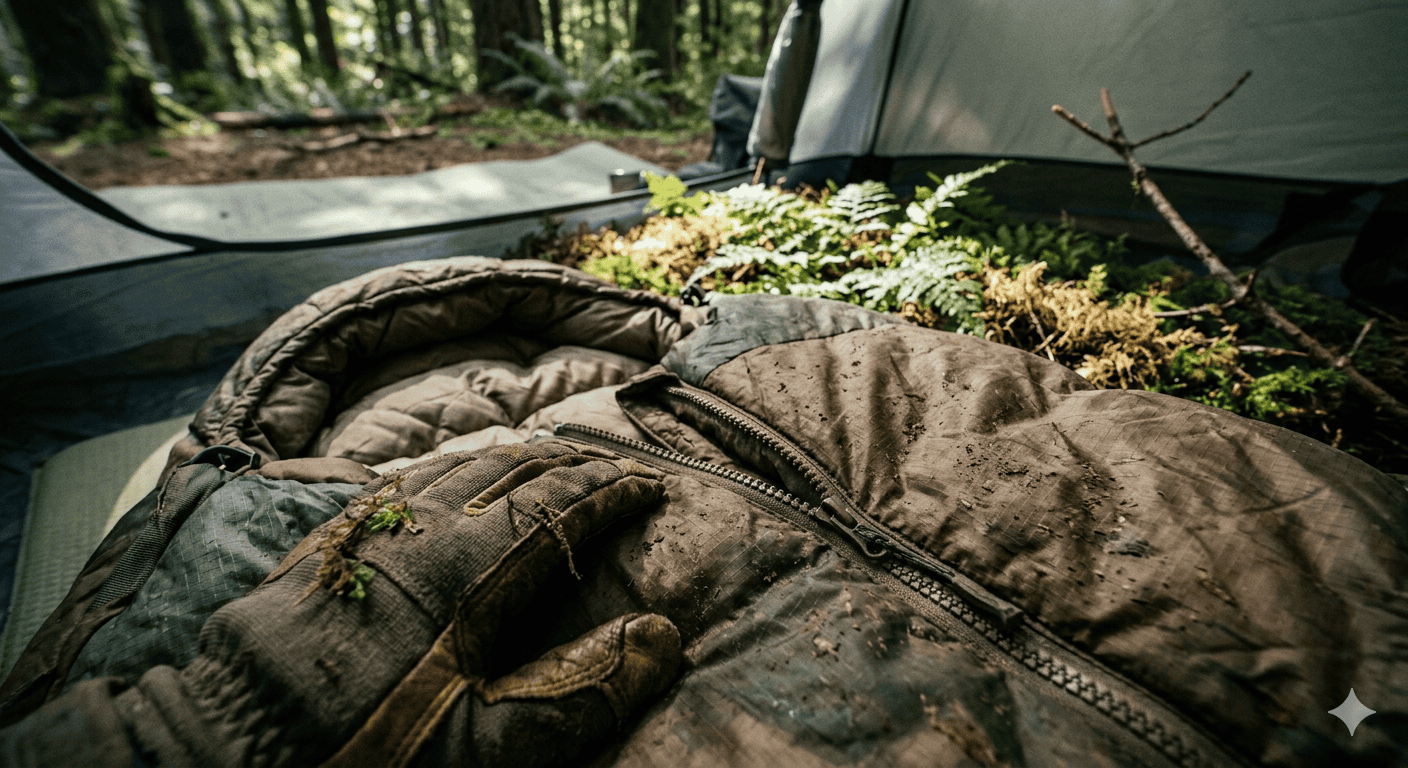
The best sleeping bags for camping are the ones rated honestly for the temperatures you actually sleep in, and most sleeping bags are not rated honestly.
Temperature ratings on sleeping bags are governed by EN/ISO standards that measure survival temperature rather than comfort temperature. A bag rated to 20 degrees Fahrenheit keeps an average person alive at 20 degrees, it does not keep them warm and comfortable. The comfort temperature for most sleepers is typically 10 to 15 degrees above the survival rating. A bag rated to 20 degrees is comfortable for most people at 30 to 35 degrees. Buying a bag rated to the temperature you expect to sleep at is the most common sleeping bag mistake new campers make, and it produces cold, miserable nights that could have been prevented. The pillow is the piece most often left behind and most regretted, and our camp pillow picks cover the packed size trade.
Getting this decision right determines the quality of your sleep on every camping trip you take. This guide researches the category to find five bags that are rated accurately and perform as described across the full temperature range most campers encounter.
For shelter that works alongside your sleeping bag, our guide to the best ultralight tents under $300 covers the top options at every budget.
What to Look for in a Camping Sleeping Bag
Temperature rating determines whether you actually sleep warm.
Use the EN/ISO comfort rating rather than the survival rating when matching a bag to your expected camping temperatures. The comfort rating reflects the temperature at which an average person sleeps comfortably, not just survives. Additionally, budget extra warmth margin for personal sleep temperature, cold sleepers need a bag rated 10 degrees warmer than their expected low temperature. Warm sleepers can use a bag rated closer to the expected low. When in doubt, a warmer bag with an unzipped ventilation option is more versatile than one that is too cold to use in lower temperatures.
Down versus synthetic fill is the most important material decision.
Down fill, from goose or duck feathers, provides the best warmth-to-weight ratio of any sleeping bag insulation and compresses significantly smaller than synthetic alternatives. The trade-off is performance when wet, down loses most of its insulating ability when moisture reaches the fill. Hydrophobic down treatments reduce but do not eliminate this vulnerability. Synthetic fill maintains meaningful insulation even when damp, dries faster, and costs less than comparable down fill. For camping in consistently dry conditions and backpacking where pack weight matters, down is the superior choice. For camping in humid, rainy, or unpredictable conditions where the bag may encounter moisture, synthetic is more reliable.
Bag shape determines how warm it sleeps at a given fill weight.
Mummy bags taper from the shoulders to the feet, matching the body’s shape to minimize dead air space that your body must heat to stay warm. They are warmer at equivalent fill weights than rectangular bags because there is less internal volume. Rectangular bags provide more interior space for movement and feel less confining, they are more comfortable for warm-weather camping and car camping, where temperature is not the primary concern. Semi-rectangular bags split the difference, more room than mummy bags, warmer than rectangular bags. For serious three-season backpacking, mummy bags are the standard. For casual summer car camping, rectangular and semi-rectangular bags are more comfortable.
Weight and pack size determine portability for backpacking use.
For car camping, sleeping bag weight and pack size are almost irrelevant, any bag fits in a car trunk. For backpacking, they become the primary specification after temperature rating. A down bag rated to 20 degrees typically weighs 2 to 3 pounds and packs to the size of a large water bottle. A synthetic bag at the same temperature rating typically weighs 3 to 5 pounds and packs to roughly twice the volume. For backpackers counting ounces, the down bag’s weight and pack size advantage is significant. For car campers, synthetic fill’s lower cost and wet-weather reliability make it the more practical choice.
The 5 Best Sleeping Bags for Camping in 2026
1. REI Co-op Trailbreak 30 Sleeping Bag
Best Overall Camping Sleeping Bag | Price: ~$90
The REI Trailbreak 30 is the sleeping bag that covers the widest range of three-season camping conditions for most campers at the most accessible price, and it does so with honest temperature ratings that reflect real-world performance rather than optimistic lab conditions.
The Honest Three-Season Workhorse
The 30-degree Fahrenheit rating is accurate for average sleepers in still, dry conditions, a meaningful distinction from budget bags that claim 30 degrees but perform more like 45. The synthetic fill maintains insulating performance in damp conditions, important for three-season camping where morning condensation inside tents is common even without rain. The semi-rectangular shape provides more interior room than a mummy bag while staying warmer than a fully rectangular design at the same fill weight.
The full-length zipper runs along the left side and can connect to compatible REI bags for a double sleeping bag configuration, useful for couples who car camp together regularly. The draft collar around the shoulders prevents warm air from escaping when temperatures drop below 40 degrees. At 3 pounds 4 ounces, it is not a backpacking bag but is completely practical for car camping, where weight is irrelevant.
PROS:
- 30-degree rating is accurate, genuinely comfortable at 35 to 40 degrees for average sleepers
- Synthetic fill maintains insulation in damp conditions
- Semi-rectangular shape provides room without the heat loss of a fully rectangular design
- Draft collar prevents warm air from escaping at the shoulders
- Full-length zipper connects to compatible REI bags for a double configuration
- REI Co-op quality and return policy
CONS:
- At 3 pounds 4 ounces, it is not suitable for backpacking
- Synthetic fill compresses significantly less than down, larger pack size
- Not suitable for temperatures below 20 degrees Fahrenheit
Best for: Three-season car campers who want a reliable, honestly rated sleeping bag that handles the full range of spring, summer, and fall camping temperatures at an accessible price.
2. Marmot Trestles Elite Eco 30 Sleeping Bag
Best Eco-Friendly Camping Sleeping Bag | Price: ~$130
The Marmot Trestles Elite Eco 30 is built from 100 percent recycled synthetic fill and recycled shell fabric, and it performs comparably to non-recycled synthetic alternatives at a price that does not penalize you significantly for the environmental consideration.
Performance Without the Environmental Compromise
The SpiraFil recycled synthetic insulation provides warmth and moisture resistance comparable to standard synthetic fill while using significantly less virgin petroleum-derived material in production. The 30-degree rating is honest, comfortable at 35 to 40 degrees for average sleepers, providing survival warmth at 30 degrees. A damp bag is often tent condensation rather than weather, which changes the fix.
The mummy shape with a semi-fitted hood maximizes warmth efficiency at the given fill weight. The full-length antisnag zipper reduces the frustrating catch that wears out sleeping bag zippers faster than any other form of mechanical stress. At 2 pounds 14 ounces, it is lighter than the REI Trailbreak, adequate for light backpacking in addition to car camping use.
PROS:
- 100 percent recycled synthetic fill and shell fabric
- SpiraFil insulation performs comparably to standard synthetic fill for warmth and moisture resistance
- Lighter than the REI Trailbreak at 2 pounds 14 ounces, suitable for light backpacking
- Full-length antisnag zipper reduces mechanical wear
- Mummy shape with semi-fitted hood maximizes warmth efficiency
- 30-degree rating is honest for average sleepers
CONS:
- Higher price than the REI Trailbreak at approximately $130
- Less interior room than the semi-rectangular REI alternative
- Recycled materials do not improve performance, equivalent to, not better than, standard alternatives
Best for: Campers who want reliable three-season performance from a bag made with recycled materials, and backpackers who want a lighter synthetic option than the REI Trailbreak.
3. TETON Sports LEEF Ultralight Sleeping Bag
Best Budget Camping Sleeping Bag | Price: ~$60
The TETON Sports LEEF is the starting point for campers who want to test camping before investing in a premium sleeping bag, and it provides genuine three-season functionality at the lowest price on this list.
At $60, the LEEF uses a mummy design with synthetic fill rated to 25 degrees Fahrenheit. The honest performance for most sleepers is comfortable at 35 to 40 degrees, in line with comparable budget bags and adequate for spring through early fall camping in most regions. The RipStop shell resists tearing on rough tent floors and abrasive surfaces better than lighter alternative shells at this price.
The compression sack packs the bag to a reasonable size for car camping and very light backpacking use. At 2 pounds 8 ounces, it is lighter than the REI and Marmot alternatives, an advantage that comes from thinner, lighter shell materials rather than superior fill technology. For occasional campers who camp a few times per year in mild conditions, the TETON LEEF provides everything needed at a price that removes all financial hesitation.
PROS:
- Most affordable option on this list is approximately $60
- Mummy design maximizes warmth at the given fill weight
- RipStop shell resists tearing on rough surfaces
- Compression sack included, packs to a reasonable size for car camping
- 2 pounds 8 ounces, lightest option on this list
- TETON Sports warranty covers manufacturing defects
CONS:
- Thinner shell materials wear faster than premium alternatives with heavy use
- 25-degree rating is comfortable for most sleepers, only at 35 to 40 degrees, not genuinely cold-weather capable
- Less durable construction than premium alternatives for high-frequency use
Best for: Occasional campers who camp a few times per year in mild conditions and want a functional starting bag at the lowest possible price before committing to a premium option.
4. The North Face Cat’s Meow Sleeping Bag
Best Three-Season Down Sleeping Bag | Price: ~$200
The North Face Cat’s Meow is the sleeping bag for campers who want down fill performance, genuinely superior warmth-to-weight ratio and significantly smaller pack size than synthetic alternatives, at a price point below the $300 to $400 range that premium down bags typically command.
Down Performance at a Fair Price
The 550-fill-power down provides a warmth-to-weight ratio that no synthetic fill at this price matches. At 2 pounds 12 ounces, it packs to roughly half the volume of the REI Trailbreak at a comparable temperature rating, a meaningful difference for backpackers where pack volume determines what else fits in the bag. Loft lasts longer when owners follow our guide to cleaning a sleeping bag safely at the end of a season.
The 20-degree Fahrenheit rating makes it genuinely usable for shoulder-season camping in late fall and early spring when temperatures drop into the 20s overnight, a significant temperature range expansion over the 30-degree synthetic alternatives. The mummy design with a full hood traps warmth efficiently at low temperatures. The Heatseeker Eco synthetic insulation lining the footbox maintains warmth in the foot area even if moisture reaches the lower bag, addressing down’s primary weakness at the most vulnerable area.
PROS:
- 550-fill-power down provides superior warmth-to-weight ratio over synthetic alternatives
- 20-degree rating extends the usable range into late fall and early spring camping
- Packs take up roughly half the volume of comparable synthetic bags
- Heatseeker Eco synthetic footbox maintains warmth if the lower bag encounters moisture
- Full hood traps warmth at low temperatures efficiently
- The North Face builds quality above average for the price
CONS:
- Most expensive option on this list is approximately $200
- Down fill loses significant warmth when wet, not ideal for humid or rainy conditions without a dry shelter guarantee
- Mummy fit is more confining than semi-rectangular alternatives
Best for: Backpackers who want down fill performance at a sub-$200 price, and three-season campers who want a bag rated honestly for late fall and early spring temperatures.
5. Coleman Brazos Cold Weather Sleeping Bag
Best Family Camping Sleeping Bag | Price: ~$35
The Coleman Brazos is the sleeping bag for family car camping, where you are outfitting multiple people at a practical total cost, at $35 per bag, equipping a family of four costs $140 rather than the $360 to $400 that four REI Trailbreak bags would cost.
The rectangular design provides the most interior room for movement, important for children and adults who find mummy bags confining. The 20-degree Fahrenheit rating is more optimistic than real-world performance for average sleepers, expect genuine comfort at 35 to 40 degrees, which covers most summer and early fall family camping scenarios.
The flannel lining feels noticeably more comfortable against skin than the nylon interior of most sleeping bags at any price, a genuine quality-of-life advantage for children who are sensitive to the slippery nylon texture. The full-length zipper connects to a second Coleman Brazos for a double bag configuration. For casual family camping where everyone sleeps in the same car camping tent, the Brazos provides functional warmth and the sleeping-in-flannel comfort that makes bedtime easier with kids. Fitting four people needs the right shelter too, covered in our family camping tent guide.
PROS:
- Most affordable option at approximately $35 per bag, practical for outfitting families
- Flannel lining is noticeably more comfortable against the skin than standard nylon interiors
- Rectangular design provides maximum interior room for movement
- Full-length zipper connects two bags for a double configuration
- Coleman brand reliability for casual camping use
- Rolls up small enough for car camping storage
CONS:
- 20-degree rating is optimistic, comfortable for most sleepers only at 35 to 40 degrees
- Rectangular design is significantly less thermally efficient than mummy bags
- Not suitable for backpacking, heavy and bulky
- Build quality reflects the price, not suitable for high-frequency use
Best for: Families outfitting multiple people for summer and early fall car camping at a practical total cost, and anyone who prioritizes flannel comfort and interior room over weight and pack efficiency.
Quick Comparison: Best Sleeping Bags for Camping 2026
| Sleeping Bag | Price | Rating | Fill | Weight | Shape | Score |
|---|---|---|---|---|---|---|
| North Face Cat’s Meow | ~$200 | 20°F | Down 550 | 2 lb 12 oz | Mummy | 9.3 |
| REI Trailbreak 30 | ~$90 | 30°F | Synthetic | 3 lb 4 oz | Semi-rect | 9.2 |
| Marmot Trestles Elite Eco | ~$130 | 30°F | Recycled syn | 2 lb 14 oz | Mummy | 9.0 |
| TETON Sports LEEF | ~$60 | 25°F | Synthetic | 2 lb 8 oz | Mummy | 8.7 |
| Coleman Brazos | ~$35 | 20°F | Synthetic | 4 lb 8 oz | Rectangular | 8.6 |
Our Verdict
For three-season car camping, the REI Trailbreak 30 at $90 is the right choice for most campers, honest temperature ratings, synthetic fill that handles damp conditions, and REI’s quality standards at an accessible price. For backpackers who want down performance without the $300-plus price of premium down bags, the North Face Cat’s Meow at $200 delivers a genuinely superior warmth-to-weight ratio and pack size at a fair price.
Eco-conscious campers who want recycled materials without sacrificing performance should consider the Marmot Trestles Elite Eco at $130. Budget campers testing the activity should start with the TETON Sports LEEF at $60, it works for mild conditions and costs $30 less than the next option. Families outfitting multiple people at a practical total cost get the best value from the Coleman Brazos at $35 per bag.
Frequently Asked Questions: Best Sleeping Bags for Camping
What is the best sleeping bag for camping in 2026? The REI Co-op Trailbreak 30 is the best overall camping sleeping bag for three-season use, honest 30-degree temperature rating, synthetic fill that handles damp conditions, and REI build quality at $90. For backpackers who need a lighter bag with superior pack size, the North Face Cat’s Meow at $200 provides down performance without the premium price of fully technical down bags.
What temperature sleeping bag do I need for camping? Target the EN/ISO comfort rating, not the survival rating. For summer camping where overnight lows stay above 50 degrees, a 40-degree bag is adequate. Also, three-season camping with overnight lows between 30 and 50 degrees, a 20 to 30-degree bag provides a comfortable warmth margin. And also, winter camping or high-altitude camping where temperatures drop below 20 degrees, a 0-degree or sub-zero bag is required. Cold sleepers should add 10 degrees of buffer to whatever temperature they expect, a cold sleeper camping at 40 degrees needs a 30-degree bag to sleep comfortably.
More Questions About Camping Sleeping Bags
How do I store a sleeping bag? Store your sleeping bag uncompressed in a large mesh or cotton storage sack, never in the stuff sack it came with for long-term storage. Compressed sleeping bag fill, whether down or synthetic, loses loft over time if kept permanently compressed between uses. Hang the bag in a closet or store it loosely in a large breathable bag. Before each camping trip, remove it from storage a day in advance and allow it to fully loft at room temperature, this restores the fill to its full warmth capacity before you need it on the trail.
Can I wash a sleeping bag at home? Yes, with the right approach. Use a front-loading washing machine on a gentle cycle with cold water and a technical fabric cleaner like Nikwax Down Wash or Techwash for synthetic bags. Never use a top-loading machine with an agitator, the agitator damages the fill clusters. Dry on low heat in a large dryer with two or three clean tennis balls, the balls break up and fill clumps and restore loft during the drying cycle. Synthetic bags dry in 2 to 3 hours. Down bags require 4 to 6 hours and multiple drying cycles to ensure the fill is completely dry, damp down develops mildew that destroys the fill permanently.
