
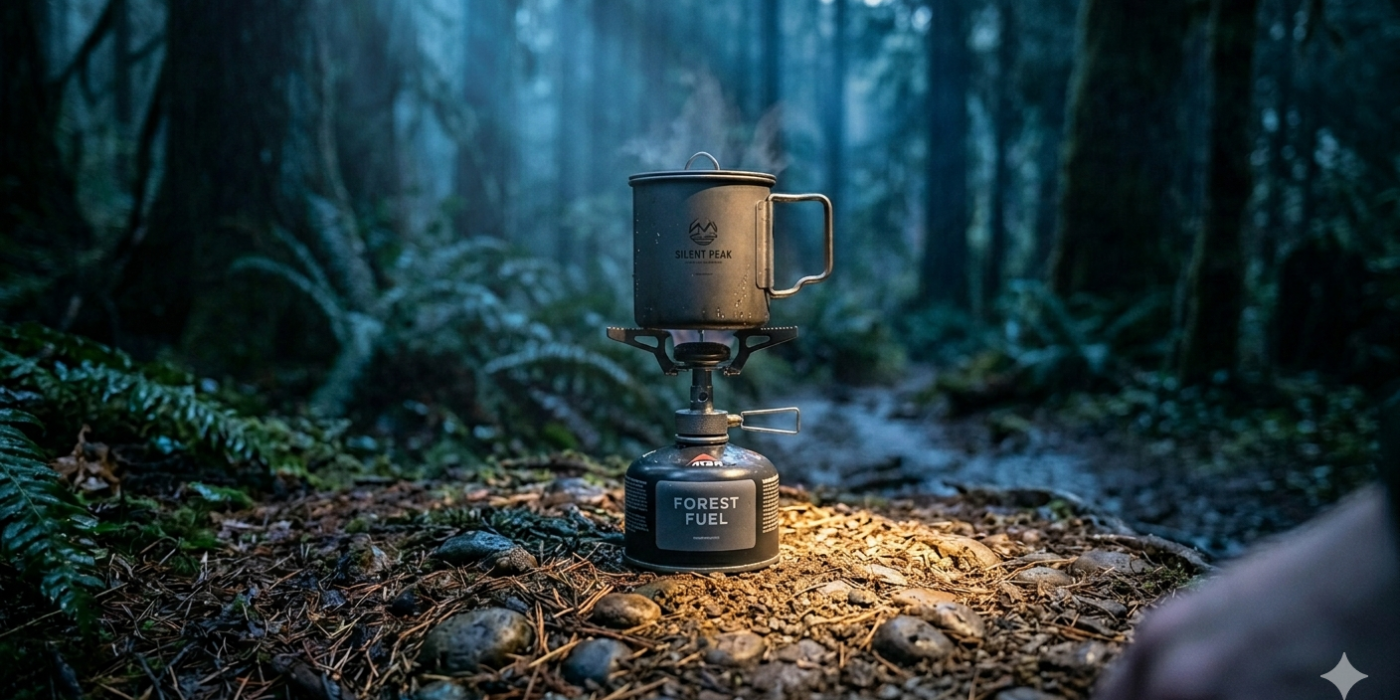
The best camp stoves for backpacking reduce one of the most satisfying parts of any backcountry trip — hot food and hot coffee after a long day on the trail — to a piece of gear you set up in 30 seconds and forget about until you need it.
A hot meal at the end of a 15-mile day is not a luxury. It is a calorie delivery system that determines how well you recover overnight and how your legs feel the next morning. Freeze-dried meals rehydrate in 10 minutes with boiling water. Coffee requires 90 seconds of boiling and a minute of steeping. The difference between a stove that boils water in 3 minutes and one that takes 8 minutes sounds minor until you are at 11,000 feet in 35-degree air, waiting for dinner while your core temperature drops.
Your backpacking stove is one of the most reliable pieces of gear in your kit — quality stoves last 10 to 15 years with basic maintenance. Getting this decision right means you will not revisit it for a decade.
Before your next backpacking trip, make sure your shelter is sorted too — our guide to the best ultralight tents under $300 covers the top shelter options for every backpacking style and budget.
What to Look for in a Backpacking Camp Stove
Fuel type determines logistics on the trail.
Canister stoves use pressurized isobutane-propane canisters — the most common backpacking fuel system, widely available at outdoor retailers and some camping stores. They are the simplest system to use — attach the stove, open the valve, light the igniter. The limitation is cold-weather performance — below 20 degrees Fahrenheit, canister fuel pressure drops significantly, and boil times increase dramatically. Alcohol stoves use denatured alcohol — cheap, widely available, and ultralight, but slow boiling and wind-sensitive. White gas stoves use liquid fuel — the most versatile system for extreme cold and high altitude, but heavier and more complex to operate. For most three-season backpacking, canister fuel is the right choice.
Boil time determines how long you wait for food and coffee.
Manufacturers measure boil time for one liter of water at sea level in calm conditions — the most favorable possible scenario. Real-world boil times at altitude, in wind, and in cold temperatures are 20 to 50 percent longer than advertised. A stove that boils one liter in 3.5 minutes at sea level may take 5 to 6 minutes at 10,000 feet in light wind. The absolute boil time matters less than the efficiency — a stove that uses less fuel to achieve the same boil produces more meals per canister and reduces the weight of fuel you carry.
Weight determines what your back notices over miles.
Every gram in your pack is a gram your back carries for the full duration of the trip. Backpacking stoves range from 25 grams for ultralight alcohol burners to 500 grams for car-camping-style stoves. For serious backpacking, the stove and fuel system combined should weigh under 200 grams — including the stove head, pot, and fuel canister for a 3-day trip. The lightest canister stoves weigh 65 to 85 grams without the canister — compact enough to fit inside a 750-milliliter pot for packing efficiency.
Wind resistance determines whether it works in real trail conditions.
Stove manufacturers test boil times in calm conditions. Most backpacking cooking happens in wind — at ridgelines, campsites with afternoon gusts, and exposed terrain where wind is a constant. A stove without a windscreen or integrated wind protection loses significant efficiency in even moderate wind — the time to boil doubles and fuel consumption increases dramatically. Integrated windscreens and recessed burner designs that block wind from reaching the flame are worth prioritizing over marginally lower weight in any stove used in exposed terrain.
The 5 Best Camp Stoves for Backpacking in 2026
#1 — MSR PocketRocket Deluxe
Best Overall Backpacking Stove | Score: 9.4/10 | Price: ~$55
The MSR PocketRocket Deluxe is the backpacking stove that experienced hikers consistently return to after trying lighter and cheaper alternatives — because the combination of fast boil time, integrated windscreen, built-in pressure regulator, and piezo igniter in a 73-gram package is genuinely difficult to improve on for three-season backpacking use.
Why the PocketRocket Deluxe Is the Benchmark
The integrated windscreen wraps around the burner head and blocks wind from reaching the flame — producing real-world performance that is closer to the advertised boil time than any open-burner alternative in moderate wind conditions. The pressure regulator maintains consistent fuel flow as the canister empties — most canister stoves produce a progressively weaker flame as fuel pressure drops, requiring longer boil times for the last third of each canister. The PocketRocket Deluxe maintains consistent performance through the full canister.
The piezo igniter lights the stove without a lighter or matches — a convenience that matters most in wet conditions where keeping a lighter dry requires specific effort. The serrated pot supports grip pots securely without slipping — a safety feature that matters when you are handling boiling water at an awkward backcountry campsite. At 73 grams, it packs inside most 750-milliliter pots for efficient packing.
PROS:
- Integrated windscreen produces closer-to-advertised boil times in real wind conditions
- Pressure regulator maintains consistent performance through the full fuel canister
- Piezo igniter lights without matches or a lighter
- 73 grams — light enough for serious backpacking without being fragile
- Serrated pot supports prevent the pot from slipping during cooking
- MSR build quality and reliability are backed by decades of backcountry use
CONS:
- Higher price at approximately $55 for a canister stove
- Requires MSR or compatible isobutane canisters — not universal fitting
- Pot not included — requires separate pot purchase
Best for: Three-season backpackers who want the most reliable all-around canister stove available — particularly those who hike in exposed or windy terrain where open-burner stoves lose significant efficiency.
#2 — BRS-3000T Ultralight Camp Stove
Best Ultralight Backpacking Stove | Score: 9.0/10 | Price: ~$16
The BRS-3000T makes an argument that is hard to dismiss — at 25 grams and $16, it is the lightest and most affordable canister stove available, and for calm-condition cooking at lower elevations, the performance is genuinely adequate for backpacking use.
The Ultralight Option That Punches Above Its Price
At 25 grams, the BRS-3000T is lighter than most alternatives by 40 to 60 grams — a meaningful weight saving for ultralight backpackers counting every gram. The titanium construction is more durable than the weight suggests — the stove folds compactly for packing and unfolds in seconds without tools. The boil time for one liter is approximately 3 minutes in calm conditions at sea level — comparable to stoves costing 10 times as much.
The honest limitation is wind sensitivity. The open burner design has no windscreen — in even moderate wind, the flame blows sideways and boil times increase dramatically. For campsites with natural wind protection or calm-condition summer backpacking, the BRS-3000T performs adequately. For exposed camping, ridge camping, or cooking in consistent wind, the MSR PocketRocket Deluxe’s integrated windscreen is worth the additional $39 and 48 grams.
PROS:
- 25 grams — lightest canister stove on this list by a significant margin
- Most affordable option at approximately $16
- Titanium construction is surprisingly durable at this weight
- Fast boil time in calm conditions — approximately 3 minutes per liter
- Folds compactly and fits inside most 500-milliliter pots
- Works with all standard isobutane-propane canisters
CONS:
- No windscreen — performance degrades significantly in moderate to strong wind
- No piezo igniter — requires a lighter or matches
- No pressure regulator — boil time increases as the canister empties
- Not suitable for cold-weather camping below 30 degrees Fahrenheit
Best for: Ultralight backpackers who camp primarily in sheltered or calm-condition environments and want the lightest possible canister stove at the lowest price.
#3 — Jetboil Flash Cooking System
Best All-in-One Backpacking Stove System | Score: 9.3/10 | Price: ~$110
The Jetboil Flash is not just a stove — it is a complete cooking system where the pot, burner, and heat exchanger are engineered to work together as a single unit. That integration produces a boiling efficiency that separate stove-and-pot combinations cannot match.
The Fastest Boiling System Available Under $150
The FluxRing heat exchanger welded to the bottom of the Jetboil pot traps heat against the pot surface rather than allowing it to escape around the sides — reducing boil time for half a liter to approximately 100 seconds in calm conditions. For backpackers who primarily make freeze-dried meals and hot drinks rather than elaborate cooking, the Jetboil Flash reduces the time spent waiting for water to boil to a genuinely trivial duration.
The color-change heat indicator on the neoprene cozy changes from blue to red when the water reaches temperature, eliminating the need to watch the pot or guess when it is ready. The system packs entirely inside the 1-liter pot — stove, igniter, and fuel canister all fit inside for compact storage. At 371 grams for the full system, it is heavier than a separate stove-and-pot combination, but the integrated efficiency and convenience justify the weight for backpackers who prioritize simplicity and speed.
PROS:
- FluxRing heat exchanger boils half a liter in approximately 100 seconds
- Color-change indicator shows when the water reaches a certain temperature
- Complete system packs inside the pot — stove, igniter, and small fuel canister included
- Push-button igniter — no lighter or matches required
- Neoprene cozy insulates the pot and protects hands during cooking
- Jetboil build quality and reliability are backed by widespread backcountry use
CONS:
- Higher price at approximately $110 for the complete system
- 371 grams total system weight — heavier than a separate stove and pot combination
- 1-liter capacity is sufficient for one person, but tight for two
- Only works efficiently with the matched Jetboil pot — loses efficiency advantage with other pots
Best for: Solo backpackers who primarily make freeze-dried meals and hot drinks and want the fastest, most convenient cooking system available without carrying separate components.
#4 — Snow Peak LiteMax Titanium Stove
Best Premium Ultralight Stove | Score: 9.2/10 | Price: ~$50
The Snow Peak LiteMax is the premium ultralight stove for backpackers who want the lowest possible weight without the wind-sensitivity compromise of the BRS-3000T — and it delivers that at 56 grams with a build quality that justifies the $50 price over the BRS at $16.
Premium Construction at a Competitive Weight
The titanium burner head produces a wide, evenly distributed flame that performs more consistently in moderate wind than the BRS-3000T’s smaller burner. The low center of gravity design — wider base than most canister stoves — reduces the tip risk that tall, narrow stoves present when carrying a full pot of boiling water at an uneven campsite. The fold-out pot supports are wider than most competitors, accommodating larger pots for two-person cooking without stability concerns.
At 56 grams, it is 31 grams heavier than the BRS-3000T but 17 grams lighter than the MSR PocketRocket Deluxe — sitting between them in both weight and wind resistance. For ultralight backpackers who want more performance than the BRS without the full weight of the MSR, the Snow Peak LiteMax is the most practical middle option.
PROS:
- 56 grams — meaningfully lighter than the MSR PocketRocket Deluxe
- Wider flame head performs more consistently in moderate wind than the BRS-3000T
- Low center of gravity reduces tip risk with a full pot
- Wide fold-out supports accommodate larger pots for two-person cooking
- Snow Peak titanium build quality — known for exceptional durability at low weight
- Compatible with all standard isobutane-propane canisters
CONS:
- No windscreen — wind performance better than BRS but below the MSR PocketRocket Deluxe
- No piezo igniter — requires a lighter or matches
- Higher price at $50 for a performance level comparable to the MSR at $55
- No pressure regulator
Best for: Ultralight backpackers who want better wind performance than the BRS-3000T without the full weight of the MSR PocketRocket Deluxe — and anyone who prioritizes premium titanium construction and low center of gravity stability.
#5 — Coleman Bottletop Propane Stove
Best Budget Camp Stove for Beginners | Score: 8.6/10 | Price: ~$25
The Coleman Bottletop is the starting point for hikers who want to try backcountry cooking before investing in a premium stove — and at $25, it provides functional cooking performance that handles basic backpacking meals without the cost of premium alternatives.
The stove uses standard Coleman propane canisters rather than isobutane — widely available at hardware stores and gas stations across the country, which makes fuel resupply easier than isobutane in areas without outdoor retailers. The single burner handles boiling water for freeze-dried meals and simple camp cooking adequately in calm conditions.
The honest limitation is weight and size — at approximately 200 grams plus the propane canister weight, the Coleman Bottletop is heavier than any other stove on this list and less suited for weight-conscious backpacking. For car camping and front-country cooking, it is completely practical. For serious backpacking where every gram matters, any of the lighter options above is a better long-term investment.
PROS:
- Most affordable stove on this list is approximately $25
- Uses widely available Coleman propane canisters — easier fuel resupply
- Functional cooking performance for basic backpacking meals
- Coleman brand reliability and straightforward warranty
- Simple operation — no learning curve
- Good starting point before investing in premium alternatives
CONS:
- Heavier than all other options on this list, at approximately 200 grams
- Propane performs poorly in cold weather below 30 degrees Fahrenheit
- No windscreen or igniter
- Better suited for car camping than serious weight-conscious backpacking
Best for: Beginning backpackers who want to try backcountry cooking at the lowest possible price before deciding whether to invest in a premium ultralight stove.
Quick Comparison: Best Camp Stoves for Backpacking 2026
| Stove | Price | Weight | Boil Time | Windscreen | Igniter | Score |
|---|---|---|---|---|---|---|
| MSR PocketRocket Deluxe | ~$55 | 73g | 3.5 min/L | Integrated | Piezo | 9.4 |
| Jetboil Flash System | ~$110 | 371g system | 100 sec/0.5L | Integrated | Push-button | 9.3 |
| Snow Peak LiteMax | ~$50 | 56g | 4.5 min/L | None | None | 9.2 |
| BRS-3000T | ~$16 | 25g | 3 min/L | None | None | 9.0 |
| Coleman Bottletop | ~$25 | 200g | 5 min/L | None | None | 8.6 |
Our Verdict
For most three-season backpackers, the MSR PocketRocket Deluxe at $55 is the right stove — the integrated windscreen, pressure regulator, and piezo igniter make it the most reliable all-conditions performer at a weight that serious backpackers can justify. For solo backpackers who primarily boil water for freeze-dried meals, the Jetboil Flash at $110 is the fastest and most convenient system available.
Ultralight backpackers counting every gram should consider the BRS-3000T at $16 for calm-condition camping — it is genuinely difficult to justify any other canister stove when weight is the primary metric in protected campsites. For ultralight backpackers in more exposed terrain, the Snow Peak LiteMax at $50 offers better wind performance at only 31 grams more. Beginning backpackers should start with the Coleman Bottletop at $25 to test the activity before committing to a premium stove.
Frequently Asked Questions: Best Camp Stoves for Backpacking
What is the best camp stove for backpacking in 2026? The MSR PocketRocket Deluxe is the best overall backpacking stove — the integrated windscreen, pressure regulator, and piezo igniter in a 73-gram package make it the most reliable all-conditions performer at $55. For solo backpackers who primarily boil water for freeze-dried meals, the Jetboil Flash at $110 is the fastest and most convenient system with its FluxRing heat exchanger and color-change temperature indicator.
How much fuel do I need for a backpacking trip? A standard 100-gram isobutane canister provides approximately 60 minutes of burn time — sufficient for 6 to 8 days of solo use for one hot meal and one hot drink per day. A 230-gram canister provides approximately 2 hours of burn time — sufficient for 2 to 3 weeks of solo use or 7 to 10 days of two-person use. Cold temperatures and wind increase fuel consumption significantly — carry an extra 100-gram canister for any trip in cold conditions or exposed terrain.
More Questions About Backpacking Stoves
Can I use my backpacking stove in all weather? Canister stoves perform adequately in three-season conditions above 20 degrees Fahrenheit. Below 20 degrees Fahrenheit, canister fuel pressure drops significantly — boil times increase dramatically, and the stove may fail to light. For winter camping and high-altitude use in consistently cold temperatures, a white gas liquid fuel stove performs more reliably in extreme cold. Warming a cold canister in your jacket or sleeping bag before use partially restores performance in moderately cold conditions, but it is not a reliable solution for sustained below-freezing temperatures.
Is a backpacking stove allowed in national parks? Canister stoves are generally allowed in national parks and wilderness areas — but fire regulations vary by location and season. Check current fire restrictions for your specific destination before every trip. During high fire danger periods, stove use may be restricted even when open fires are prohibited — always verify current regulations with the specific park or wilderness area management agency before assuming your stove is permitted.
