
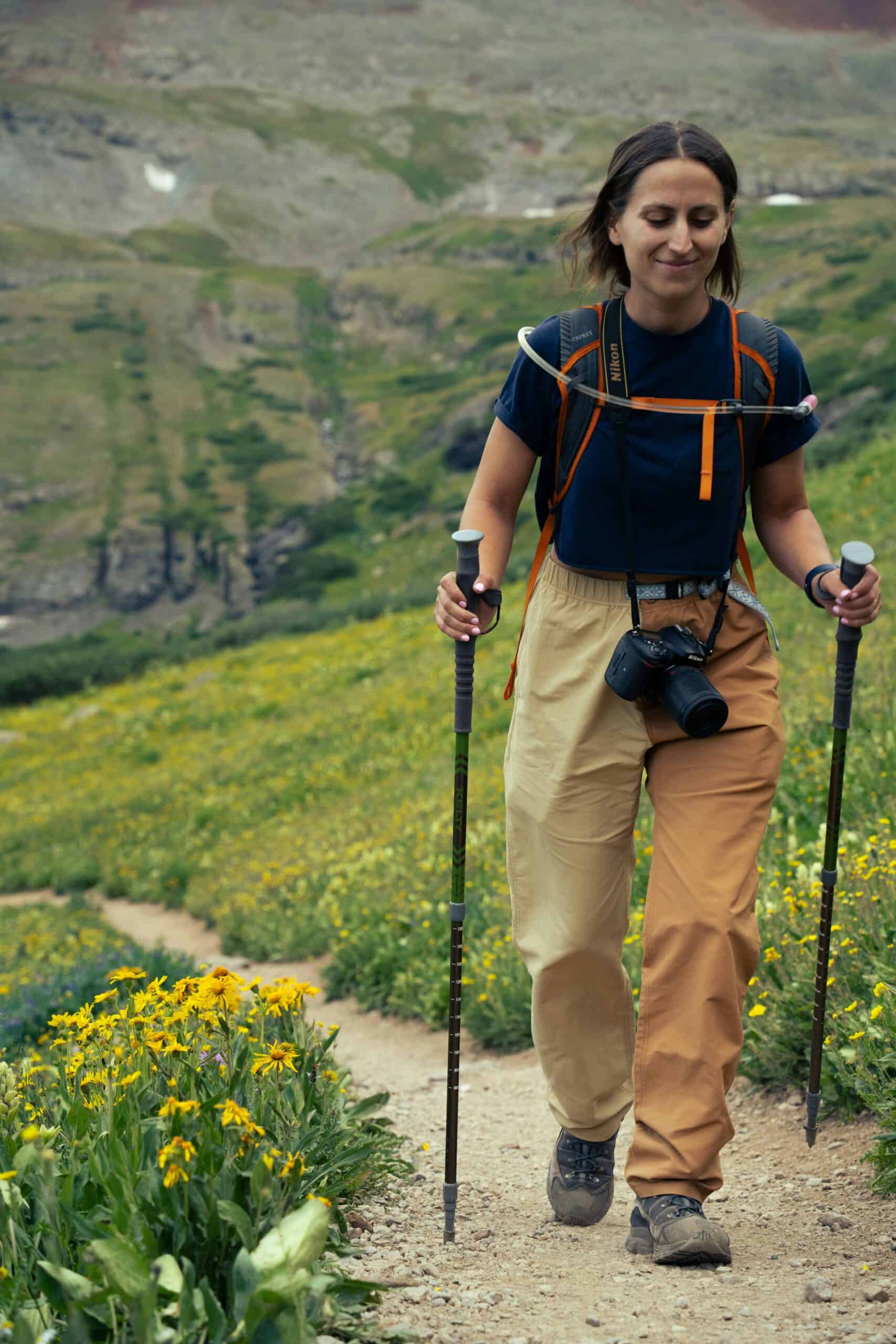
Walk into any trailhead parking lot, and you will see both, hikers with two lightweight trekking poles moving efficiently up the switchbacks, and hikers with a single wooden staff planted deliberately with each step. Both groups look comfortable. Both approaches have been used for centuries. And both camps have strong opinions about why the other group is doing it wrong.
The honest answer is that neither is categorically better, the right choice depends on what you are hiking, how you hike it, and what specific benefit you are looking for from a walking aid. Trekking poles and hiking staffs address overlapping, but not identical problems on the trail, and understanding the difference determines which tool actually serves your hiking style rather than just matching the gear choice of the most people you see on the trail.
For readers who have decided on trekking poles and want the best options, our guide to the best trekking poles covers the top options at every price point. Hikers who want to protect their knees on descents, regardless of which option they choose, will find useful context in our best hiking boots for beginners guide, boot ankle support and pole use work together as a stability system. And for the pack that carries your trekking poles when terrain makes them impractical to use, our best hiking daypacks guide covers pole attachment systems worth knowing before you buy.
What Each Option Actually Does
Trekking poles are two lightweight adjustable poles, typically carbon fiber or aluminum, used in alternating rhythm with the legs to create a four-point contact system with the trail surface. The alternating rhythm mirrors natural arm swing during walking and distributes effort across the upper and lower body simultaneously. They fold or collapse for storage and adjust to different lengths for uphill, downhill, and flat terrain.
A hiking staff is a single pole, typically wood, bamboo, or a single trekking pole used alone, that provides a third point of contact with the trail surface. It functions as a balance aid and probing tool rather than a bilateral loading system. The single-pole contact is used more selectively than the continuous bilateral rhythm of trekking poles, planted for stability on technical steps and crossings rather than used on every stride.
Trekking Poles vs Hiking Staff: The Direct Comparison
Joint protection on descents
Trekking poles win clearly on joint protection during descents. Studies on trekking pole use consistently show a meaningful reduction in compressive knee force during downhill walking when poles are used correctly, the bilateral pole contact distributes some of the descent braking load from the knee joint to the arms and upper body. A single hiking staff provides one-sided braking assistance that reduces knee load on one leg while leaving the other leg to manage full descent force without assistance. For hikers managing knee pain or hiking significant elevation loss regularly, the bilateral protection of two poles is the clinically supported choice.
Balance and stability on technical terrain
Both options improve balance on technical terrain, creek crossings, rocky scrambles, and slippery surfaces. The hiking staff provides a single stable probe point that most hikers use more deliberately and effectively than the constant bilateral pole contact of trekking poles. Many experienced hikers find a single staff more intuitive for balance on very technical terrain, where two poles create arm coordination complexity that a single staff eliminates. The hiking staff’s advantage is simplicity, one point of contact to place deliberately rather than two to coordinate simultaneously.
Uphill climbing efficiency
Trekking poles improve uphill efficiency by engaging the upper body in the climbing effort, each pole plant pulls the body forward and reduces the lower body workload on sustained climbs. Studies show meaningful reduction in perceived exertion during uphill hiking with trekking poles versus without them. A hiking staff provides some uphill assistance on steep sections but less systematically than bilateral poles used in alternating rhythm, the single contact point pushes rather than pulls the body forward and engages the upper body less continuously than two poles.
Natural arm swing and hiking feel
A hiking staff wins on natural feel for many hikers. The single staff allows the non-staff arm to swing naturally, maintaining the asymmetrical arm swing that the body uses during normal walking. Trekking poles engage both arms in a continuous alternating rhythm that feels natural during sustained hiking but more mechanical and choreographed than the selective use of a single staff. Hikers who want trail walking to feel like walking rather than Nordic skiing often prefer the staff for this reason.
Pack weight and storage
Trekking poles collapse to 24 to 28 inches for daypack side pocket storage, small enough to carry without taking up meaningful pack space when terrain makes them impractical. Quality carbon fiber trekking poles weigh 8 to 14 ounces per pair, negligible weight for the benefits they provide. A traditional wooden hiking staff is heavier, does not collapse, and requires either carrying in hand or strapping awkwardly to the outside of a pack when not in use. Lightweight single-pole alternatives using a single trekking pole as a staff split the difference, collapsible for storage at half the weight of a pair. Our note on why do my trekking poles collapse when i lean on them covers that in more detail.
Who Should Choose Trekking Poles
Trekking poles are the better choice if:
- You hike trails with significant elevation gain and loss, where knee protection on descent is a priority
- You cover long distances where upper body engagement reduces overall fatigue meaningfully
- You backpack with heavy loads, where bilateral stability and load distribution across four contact points matter more than natural arm swing
- You hike in winter or shoulder season conditions, where bilateral pole contact improves balance on snow and ice
- You want to use poles for tent staking with ultralight shelters that use trekking poles as structural supports
Best trekking poles option:
Who Should Choose a Hiking Staff
A hiking staff is the better choice if:
- You hike primarily on established trails with moderate terrain, where selective stability assistance matters more than continuous bilateral support
- You prefer the feel of natural arm swing during trail walking over the coordinated bilateral rhythm of two poles
- You hike shorter distances, where upper-body fatigue reduction from poles is less meaningful
- You want a single piece of gear that doubles as a camera monopod, shelter prop, or wildlife deterrent
- You find the coordination of two poles more distracting than helpful on the terrain you primarily hike
Best hiking staff option:
The Verdict: Which Is Actually Better
For most trail hikers, the trekking poles win on measurable performance metrics. The bilateral knee protection, uphill efficiency, and load distribution advantages are documented and meaningful for hikers who cover significant elevation and distance regularly.
For casual and moderate trail hikers who value natural feel over performance optimization, a hiking staff is a completely legitimate choice that provides meaningful stability assistance without the coordination overhead of two poles. Generations of experienced mountain hikers used single staffs exclusively and hiked terrain that would challenge most modern pole users.
The honest middle ground: A single trekking pole used as a staff, collapsible, adjustable, and available in carbon fiber at 4 to 6 ounces, gives you the storage and weight advantages of modern trekking pole construction with the single-point contact feel of a traditional hiking staff. Many experienced hikers settle on this compromise after trying both bilateral poles and traditional staffs. Our best trekking poles guide covers the best single-pole-capable options if this approach appeals to you.
Frequently Asked Questions: Trekking Poles vs Hiking Staff
Are trekking poles better than a hiking staff?
Trekking poles are measurably better for joint protection on descents and uphill efficiency, the bilateral contact and alternating rhythm provide documented knee force reduction and upper body engagement that a single staff cannot replicate. A hiking staff is better for a natural trail feel, selective balance assistance on technical terrain, and simplicity of use for hikers who find pole coordination more distracting than helpful. The right choice depends on your hiking terrain and what you want from a walking aid.
Do I really need trekking poles for hiking?
No, trekking poles are a performance tool that improves the hiking experience rather than a safety requirement for most trail conditions. Hikers have completed demanding trails without poles for as long as trails have existed. The meaningful benefits, knee protection on significant descents, upper body engagement on long climbs, and stability on technical terrain, matter more as trail difficulty, pack weight, and total mileage increase. For casual day hikers on moderate established trails, poles are a useful addition rather than a necessity.
Can I use one trekking pole instead of two?
Yes, using a single trekking pole as a hybrid staff is a common approach among experienced hikers. You get the collapsible storage and adjustable length of modern pole construction with the single-contact-point feel of a traditional staff. The bilateral knee protection benefit of two poles is reduced to one-sided assistance, which still provides meaningful support on the dominant pole side. Many hikers find one pole on descents more intuitive and effective than two, worth trying before committing to the bilateral pole technique.
How long should a hiking staff be?
A hiking staff should reach approximately to the wrist when held with the arm hanging naturally at the side, roughly equal to your height in centimeters minus 15 to 20 centimeters, or your height in inches expressed as centimeters. A staff that is too long forces the shoulder into elevation, which causes upper arm fatigue. A staff that is too short requires bending at the elbow to plant it effectively. Adjustable trekking poles used as a single staff allow you to dial in the correct length, slightly shorter for uphill travel and slightly longer for downhill travel, which fixed-length wooden staffs cannot accommodate.
