
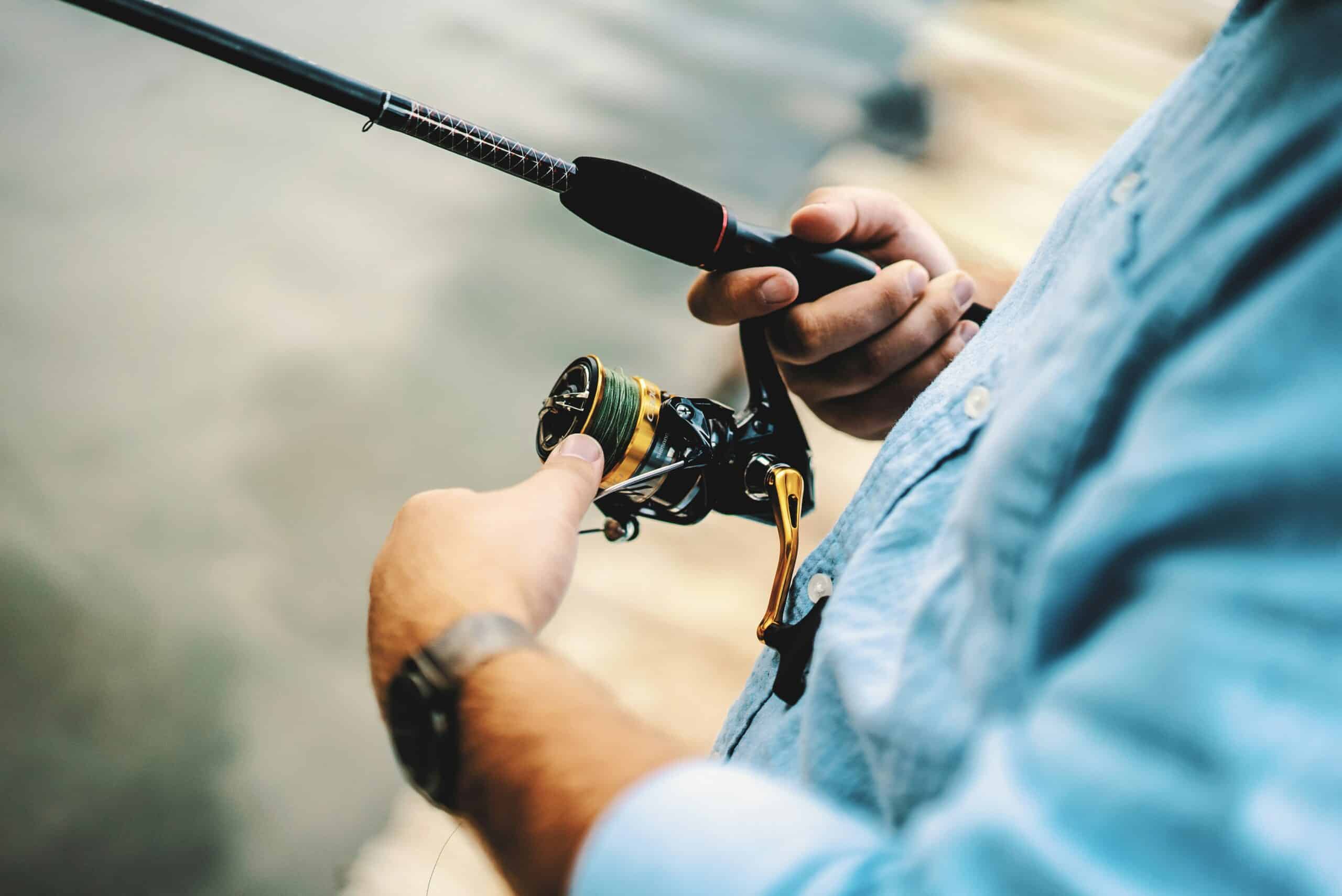
Casting a fishing rod looks simple from the boat and feels awkward the first hundred times you try it. The mechanics combine timing, wrist motion, and trigger release in a sequence that has to happen smoothly or the line piles on the rod tip instead of flying toward the water. Most beginner frustration comes from trying to power the cast with arm strength when the rod itself does the work; the angler’s job is to load the rod with motion and release at the right moment.
This guide walks through four casts that cover almost every situation a new angler will face: the overhead cast (the all-purpose default), the sidearm cast (for low overhanging cover), the roll cast (for tight quarters with no backcast room), and the pitch and flip (for accurate short-range placement near structure). Each gets a step-by-step procedure and the common ways beginners get it wrong.
Practice in an open yard before going to the water. A backyard hour with a hookless practice plug builds more skill than four hours of frustrated lake-side flailing.
Key Takeaways
- Power comes from the rod loading and releasing, not from your arm. The cast feels like a smooth wave, not a chop.
- The release timing on a spinning reel happens between the 1 and 2 o’clock positions during the forward stroke. Earlier sends the lure up; later sends it into the water in front of you.
- The most common beginner failure is gripping too tight and trying to muscle the cast. Loose grip and fluid motion produce longer and more accurate casts.
- Match the cast type to the situation. Overhead works in open water; sidearm and roll casts are necessary under cover.
Why Casting Mechanics Matter More Than Gear
A good cast with mid-range gear outperforms a poor cast with premium gear, by a wide margin. The cast determines where the lure lands, how naturally it enters the water, and whether the angler can place it under cover or near structure where fish actually hold. Distance matters less than accuracy in most fishing situations.
The reason beginners struggle is that casting works against intuition. The natural instinct is to throw the lure with arm strength, the way you’d throw a baseball. Casting actually works through rod loading: the backstroke bends the rod against the weight of the lure, storing energy. The forward stroke releases that energy, which propels the lure. The arm provides the motion; the rod provides the power.
This is why a smaller angler with good mechanics casts farther than a bigger angler with poor mechanics. The rod does the work.
Rod and reel selection affects how forgiving the gear is during the learning curve. Beginner-friendly combos with moderate action rods are easier to learn on than fast-action rods that require more precise timing. Our roundup of best fishing rod and reel combos for beginners covers the picks suited to learning the cast.
What You Need to Practice
Three things, plus an open space.
A rod and reel combo appropriate for your target fishing style. Spinning reels are easier to learn than baitcasters; nearly all new anglers start with spinning gear.
A practice plug or hookless lure matching the weight you’d actually fish. Light lures (under quarter ounce) don’t load the rod well during learning; quarter-ounce to half-ounce practice plugs work best.
Open space with at least 50 feet of clear ground or water in front and 20 feet behind. A backyard, soccer field, or empty parking lot works for dry-land practice.
Optional: a soft target like a hula hoop or bucket to aim at. Practice without a target builds raw distance; practice with one builds accuracy.
Cast 1: The Overhead Cast
The overhead cast is the default. Most fishing situations use this cast unless cover or wind makes it impractical.
The procedure with a spinning reel:
- Hold the rod with two fingers in front of the reel stem and two behind, with the line resting on your index finger trigger position.
- Open the bail with your other hand. The line is now held only by your trigger finger.
- Position the lure about a foot below the rod tip.
- Bring the rod tip back smoothly until it’s slightly past vertical, around the 1 o’clock position. The rod bends against the weight of the lure during this motion.
- Without pausing, sweep the rod forward smoothly. The rod releases the stored energy.
- Release the line from your trigger finger as the rod passes the 10 o’clock position on its forward stroke.
- Follow through, pointing the rod tip toward the target.
- Close the bail manually with your other hand once the lure lands, then begin retrieve.
The whole motion is one smooth stroke, not a back-pause-forward sequence. Pausing at the back position lets the loaded rod release its energy backward, killing the cast.
Common failures: releasing too early (lure goes straight up); releasing too late (lure goes into the water at your feet); using too much arm power (rod doesn’t load efficiently and accuracy suffers); not opening the bail (line doesn’t release at all).
Cast 2: The Sidearm Cast
The sidearm cast keeps the lure low to the water and the rod path under any overhanging cover. Useful around docks, trees with low branches, or in windy conditions where keeping the lure low reduces wind effects.
The procedure:
- Hold the rod in normal casting grip.
- Open the bail and hold the line with your trigger finger.
- Position the rod horizontally at about waist height, pointing away from your body.
- Sweep the rod back smoothly along the horizontal plane until it’s pointing behind you. The rod loads against the lure weight as in the overhead.
- Sweep forward smoothly along the same horizontal plane.
- Release the line as the rod passes through the forward position aiming at your target.
- Follow through with the rod tip pointing at the target.
The release point is the equivalent of 10 o’clock in the overhead cast but rotated 90 degrees onto the horizontal plane.
Common failures: dipping the rod tip during the forward stroke (sends the lure into the water short of target); releasing too early on the horizontal plane (sends the lure off to the side instead of forward); using too wide a backstroke (catches surrounding vegetation).
Best for: fishing around docks, under tree branches, in windy conditions, or any situation where the overhead cast doesn’t fit the environment.
Cast 3: The Roll Cast
The roll cast is the answer when there’s no room for a backcast. Common scenarios include fishing from a kayak with branches behind you, casting in very tight quarters along a creek, or fishing from a boat with passengers behind.
The procedure:
- Open the bail. Hold the line with your trigger finger.
- Position the rod tip near the water with several feet of line out in front, the lure resting on or near the water surface.
- Lift the rod tip back smoothly until it’s behind your shoulder. The line drags through the water and creates resistance that loads the rod.
- Without a true backcast (the line stays on or near the water), sweep the rod forward in a smooth motion.
- Release the line as the rod passes the 10 o’clock position.
- The line rolls forward in a wave from the water surface, carrying the lure to the target.
The roll cast has shorter maximum distance than the overhead but is the only option in restricted-backcast situations.
Common failures: trying to power the roll cast with arm motion (it relies on water tension on the line for loading); too short a backstroke (insufficient load); not maintaining line tension during the back motion.
Best for: kayak fishing, dense overhead cover, tight creek banks, and any other situation without backcast room.
Cast 4: The Pitch and Flip
Pitching and flipping are short-distance casts designed for accurate placement under cover or near specific structure. Common in bass fishing around docks, in submerged vegetation, or alongside laydowns.
The procedure for pitching (slightly longer range than flipping):
- Open the bail. Hold the line with your trigger finger.
- Hold the lure with your non-rod hand, with several feet of line between lure and rod tip.
- Position the rod parallel to the water and low to the surface.
- Release the lure from your hand while smoothly lifting the rod tip.
- The lure swings forward in a low pendulum motion.
- Release the line from your trigger finger as the lure passes over the target.
- The lure enters the water with minimal splash, which spooks fewer fish than a high-arc cast.
Flipping is essentially the same motion at even shorter range, used when the angler is right above the target spot.
Common failures: releasing the lure too early from the non-rod hand (cast goes high); releasing too late (cast goes short); too much line out (less control); not maintaining low rod path (high arc and loud splash).
Best for: short-range accurate placement, fishing near structure, situations where lure splash spooks fish.
📑 Recommended Read: Reading the water tells you where to cast as much as how to cast tells you how to deliver the lure there. Check out our complete guide on how to read water when fishing for the visual cues that point to where fish actually hold.
Casting With Different Reel Types
The basic mechanics are similar across reel types, but the line-release method differs.
Spinning reels: Open the bail manually before casting, release line from a trigger finger during the cast. Most beginner-friendly. Backlashes don’t happen because the line peels off the spool freely.
Baitcasting reels: Press a thumb release button before casting, control line speed with thumb pressure on the spool during flight. More accurate at intermediate distances but prone to backlashes (“bird’s nests”) when the spool spins faster than the line releases. Worth learning after spinning gear is comfortable.
Spincast reels: Push-button release on the back of the reel. Easiest mechanism, common on kids’ rods and some basic combos. Limited line capacity and casting distance.
For anglers focused on bass fishing specifically, the rod choice affects casting accuracy at typical bass distances. Our roundup of best bass fishing rods covers the picks paired with appropriate reel types.
Common Mistakes and How to Avoid Them
Gripping too tightly. Tense hands transfer tension into the cast, killing the smooth motion the rod needs to load and release. Hold the rod firmly enough not to drop it; that’s all.
Trying to power the cast with arm strength. The rod does the work. Smooth motion loads the rod; arm power just produces jerky casts that don’t load efficiently.
Pausing at the back of the stroke. Breaks the smooth motion and lets the rod unload backward. Backstroke flows directly into forward stroke without pause.
Casting only at maximum distance. Most fish are caught at moderate distances. Accuracy at 30 to 50 feet matters more than reach.
Not adjusting for wind. Casting into wind loses distance; with the wind helps. Adjust target and cast force accordingly.
Skipping practice without a target. Casting toward nothing trains distance but not accuracy. Always cast toward something specific.
Not adjusting cast type to situation. Overhead in tight quarters catches branches; roll cast in open water loses distance unnecessarily. Match the cast to the environment.
Frustration accelerating bad habits. When the cast isn’t working, slow down rather than speeding up. Speed comes after the mechanics are right.
Frequently Asked Questions
What cast should I learn first? The overhead cast with a spinning reel. It works in most situations and the spinning reel has the most forgiving release.
How long until I can cast accurately? A few hours of focused practice gets most people to functional accuracy at moderate distances. Real precision (placing the lure in a one-foot target circle at 40 feet) takes many fishing trips.
Why does my lure keep landing at my feet? Late release. The line stays connected to your trigger finger past the optimal release point, so the rod’s forward motion goes into the water rather than flinging the lure forward. Release earlier in the stroke.
Why does my lure go straight up? Early release. The line comes off your trigger finger before the rod has rotated forward, sending energy upward instead of toward the target. Release later in the stroke.
How far should I be able to cast? Varies by gear and conditions. A typical spinning combo with a quarter-ounce lure can cast 40 to 70 feet comfortably for a beginner, 80 to 120 feet for experienced anglers. Distance grows with practice.
Should I use heavier line for easier casting? No. Heavier line is harder to cast because it creates more drag and reduces distance. Match line weight to target fish, not casting comfort.
Can I learn baitcasting first instead of spinning? Possible but harder. Baitcasters require thumb control to prevent backlashes that spinning reels don’t experience. Most anglers learn spinning first, then add baitcasting after the basic mechanics are familiar.
Does casting in wind require different technique? Yes. Cast lower (sidearm or modified low overhead) into headwinds to reduce wind drag. Use sidearm casts in crosswinds to control direction. Adjust target downwind of intended location and let the wind drift the lure.
