
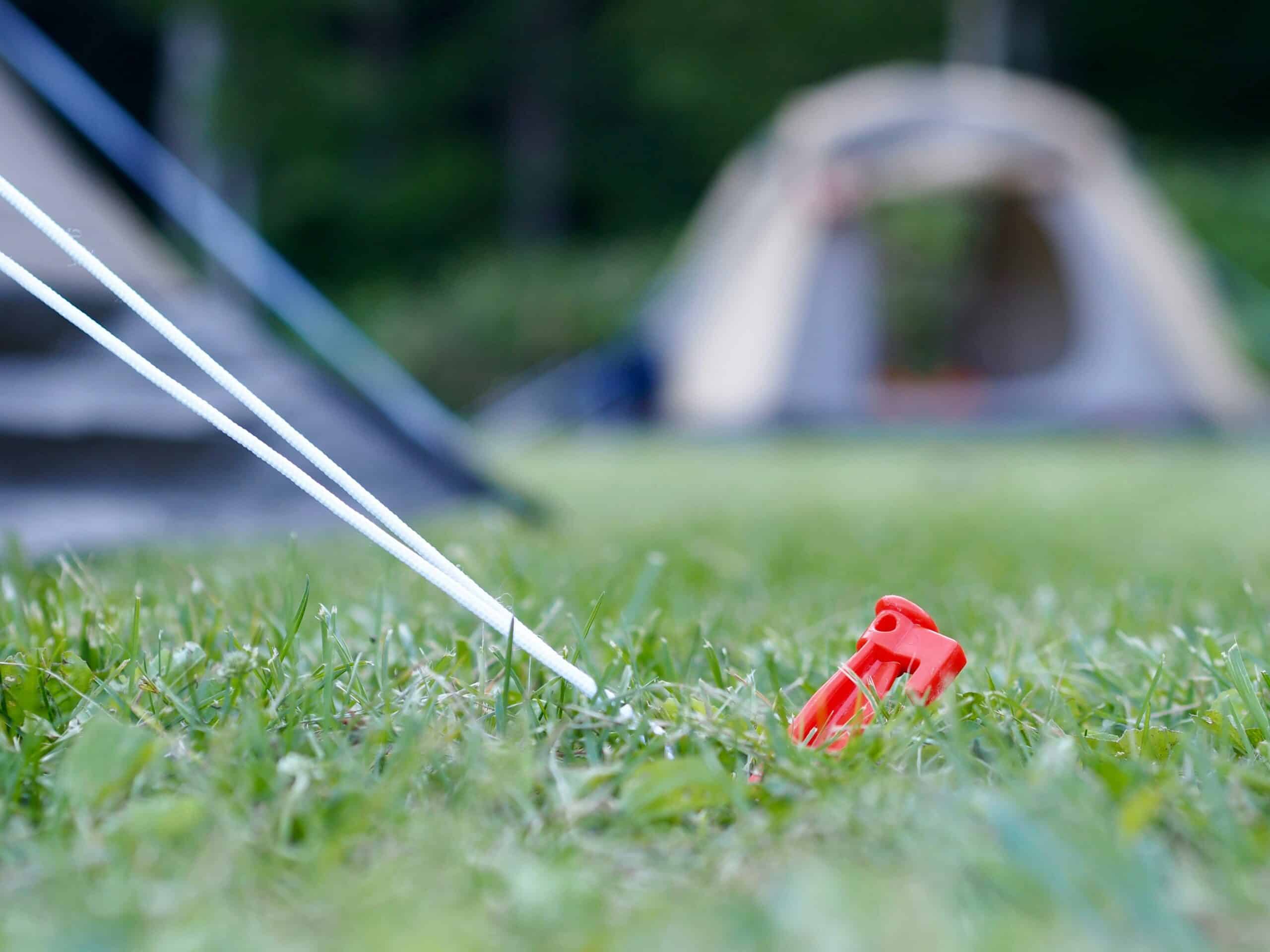
Tent stakes and guylines are the anchoring system that transfers wind load from the tent fabric into the ground, and they are almost always the weakest part of the setup. Tent stakes shipped in the bag are usually thin and short because manufacturers are shaving grams off a headline weight, which is why upgrading them is the cheapest real improvement most tents can get. Our roundup of two-person backpacking tents covers the shelter itself.
Stake choice comes down to ground. Hard packed dirt, loose sand and deep snow each want a different shape, and no single stake covers all three.
Guylines matter just as much and get ignored more. A tent pitched without its guylines out is a tent relying entirely on its poles.
Quick Verdict
Carry Y-beam or V-shaped aluminum stakes as the default, since they hold far better than the round pins most tents ship with and weigh very little more. Add a couple of heavier steel or nail-style stakes for hard ground, and swap the stock guylines for reflective cord with proper tensioners. Match the stake to the ground, not to the tent.
Key Takeaways
- Stock stakes are usually the cheapest part of a tent and the first to fail.
- Surface area holds in soft ground; strength holds in hard ground.
- Y-beam and V-shaped stakes resist rotating under load, round pins do not.
- Reflective guyline stops the nighttime trip hazard.
- Guylines only work when tensioned, not merely attached.
How We Picked
This is a research-based roundup rather than a hands-on field test. Selections rest on published specifications, stated materials and dimensions, manufacturer guidance and consistent user-reported feedback rather than on our own measurement.
The criteria that mattered were cross-sectional shape, material and its bending behavior, length relative to intended ground, a head that takes a guyline without cutting it, and whether the stake can be pulled without a tool.
Weight claims were treated in context. A very light stake that bends on the first rocky pitch is not light, it is disposable.
Ground conditions vary enormously between regions, so treat any recommendation as a starting point for the terrain you actually camp on.
Y-Beam Aluminum Stakes
Why It Stands Out
The Y cross-section is the reason these hold. Three fins mean the stake cannot rotate in the ground, and rotation is how a round pin works itself loose under a flapping fly.
They also present far more surface area than a pin of similar weight, which matters in anything softer than packed dirt.
Worth Knowing
Aluminum bends rather than snaps, so a hard strike on a buried rock leaves a curved stake you can usually straighten. That is a feature, though it does mean they gradually deform.
The fins collect mud and want a wipe before they go back in the bag, otherwise the whole set arrives gritty next trip.
This suits general backpacking on mixed ground. Skip it for genuinely rocky ground, where a stronger steel stake survives better.
Steel Nail Stakes for Hard Ground
Why It Stands Out
Steel takes a hammer. On sun-baked ground, gravel or compacted campsite dirt, an aluminum stake folds and a steel nail stake goes in.
The narrow profile is an advantage here, because in hard ground holding power comes from the ground itself rather than from surface area.
Worth Knowing
Weight is the obvious cost, and a full set of steel stakes is noticeably heavier than aluminum. Carrying a few rather than a full set is the usual compromise.
They rust if put away wet, so they want drying more than aluminum does.
This suits established campsites and dry compacted ground. Skip a full set for long backpacking trips, where the weight adds up.
Sand and Snow Stakes
Why It Stands Out
Loose ground reverses the logic entirely. In sand or snow there is nothing to grip, so holding power comes from sheer buried surface area, which is why these are wide flat blades rather than pins.
Many are designed to be buried horizontally as a deadman anchor rather than driven vertically, which holds far better in snow.
Worth Knowing
They are bulky and awkward to pack, and they are close to useless in hard ground where they simply will not penetrate.
Cord holes need checking. A sharp-edged hole saws through guyline over a season.
This suits beach, desert dune and winter camping. Skip it as a general-purpose stake, since it only works where it works.
Titanium Shepherd Hook Stakes
Why It Stands Out
Titanium shepherd hooks are the ultralight answer. They weigh very little, resist bending better than aluminum of the same weight, and take up almost no room.
For a tarp with several tie-outs where each anchor carries a modest load, this is a sensible way to save weight, and our roundup of camping tarps covers the shelters that suit them.
Worth Knowing
The round profile rotates under load, which is the same weakness the stock stakes have. They hold acceptably in firm ground and poorly in soft.
The hook can also let a guyline lift off if tension slackens, so a proper loop over the hook matters.
This suits ultralight setups on firm ground. Skip it for exposed windy pitches, where rotation becomes a real failure mode.
Reflective Guyline Cord
Why It Stands Out
Reflective cord solves a problem that has nothing to do with holding a tent down. A guyline you cannot see at night is something people walk into, and doing so rips out a stake at best.
Upgrading cord also usually means upgrading from the thin stock line to something that handles better in cold and wet.
Worth Knowing
Thicker is not automatically better. Very thick cord is heavy, holds water and does not run smoothly through small tensioners.
Stretch matters. A line with some give absorbs gusts, while a completely static line transfers every shock straight into the stake.
This suits any tent pitched near a walking route or shared campsite. Skip it only if your stock lines are already reflective.
Line Tensioners and Guyline Runners
Why It Stands Out
A tensioner is what turns an attached guyline into a tightened one. Aluminum runners let you take up slack with one hand, in the dark, without untying anything.
They also let you re-tension overnight, which matters because nylon lines sag as they absorb moisture.
Worth Knowing
Cord diameter has to match the tensioner. Too thin and it slips, too thick and it jams, so buy them together rather than separately.
Some very light tensioners cut into soft cord over time, which is worth checking at the start of a season.
This suits anyone whose tent sags by morning. Skip it if your tent has integrated tensioners already built into the fly.
Tent Stakes and Guylines at a Glance
| Type | Ground | Trade |
|---|---|---|
| Y-beam aluminum | Mixed, general | Bends on rock |
| Steel nail | Hard, compacted | Heavy, can rust |
| Sand and snow | Loose, deep | Bulky, useless in hard |
| Titanium hook | Firm, ultralight use | Rotates under load |
| Reflective cord | Any | Thicker is not better |
| Tensioners | Any | Must match cord size |
How to Choose Tent Stakes and Guylines
Buy for the ground, not the tent
The tent decides how many anchors you need and the ground decides what shape they should be. Most people carry a mixed set for exactly this reason.
Prefer a shape that cannot rotate
Y-beam and V-shaped stakes stay put because the ground grips three faces. Round pins rotate, and rotation is how a stake walks itself out overnight in wind. Stakes hold best in the right soil, which is one more reason choosing where to pitch matters.
Check the head takes cord kindly
A sharp-edged hole or a rough hook will chew through guyline. Look for a rounded notch or a smooth hole, since the stake outlives several sets of cord.
Count your tie-outs before buying a set
Tents ship with the bare minimum. Adding the vestibule and mid-panel guy points that most tents include but few people use is what actually steadies a fly in wind.
Stakes or Rocks
When stakes win
Almost always, on ground that takes them. A driven stake resists a pull straight upward, which is the direction wind actually loads a guyline, and it does so at a known angle you can set deliberately. Rocks resist sideways pull well and vertical pull poorly, which is the wrong way round.
When rocks win
Where nothing will go in. Slabby alpine ground, frozen surfaces and thin soil over bedrock all defeat stakes entirely, and there a heavy rock over a buried loop or a line tied around a boulder is the only option. The technique matters more than the anchor here, since a line tied low around a rock pulls sideways rather than lifting it. Our comparison of tent against hammock camping is worth a look if hard ground is your normal terrain, because a hammock sidesteps the problem.
What Trips People Up
Driving stakes straight down
A stake angled away from the tent, leaning back against the pull, holds far better than a vertical one. Straight down is the most common pitching error and the easiest to fix.
Leaving the guylines coiled
A tent with its lines wrapped around the poles is relying on the poles alone. Deploying the guy points is free and it is the difference between a steady fly and a noisy one.
Pulling stakes out by the cord
Yanking a guyline to extract a stake bends the stake and frays the line. A second stake hooked under the head lifts it cleanly, which is why a spare in the pocket is useful.
Skipping the mid-panel guy points
Most tents include tie-outs partway up the fly that almost nobody uses. Those are what stop the fabric drumming in wind, and our roundup of ultralight backpacking tents covers shelters where that matters most.
Recommended Reading
See our roundup of ultralight tents under 300, our roundup of lightweight sleeping pads, our roundup of trekking pole accessories, which includes a stake designed to work with poles, and our roundup of camping shovels and trowels.
Tent Stakes and Guylines FAQ
Are the tent stakes that come with a tent good enough?
Usually not. Manufacturers fit thin round pins to keep the advertised weight down, and those rotate and pull out in wind. Upgrading to Y-beam or V-shaped aluminum is one of the cheapest meaningful improvements available to any tent.
What angle should a tent stake go in at?
Leaning away from the tent, so the stake resists the pull rather than being levered upward by it. Somewhere around a slant rather than vertical is the target, and driving it straight down is the most common pitching mistake.
How many stakes do I actually need?
Count the tent’s corner points, then add every guy point on the fly including the mid-panel ones people usually ignore. Carrying a few spares on top of that covers bent stakes and pitches where one refuses to go in.
Do I need different stakes for sand?
Yes. Loose ground offers nothing to grip, so holding power comes from buried surface area, which means wide flat stakes rather than pins. In snow they often work better buried horizontally as a deadman anchor than driven in.
Why does my tent sag overnight?
Nylon guylines absorb moisture and stretch, so a fly tensioned at dusk is slack by midnight. Line tensioners let you take the slack out without untying anything, which is why they are worth fitting.
Is titanium worth it over aluminum?
For weight, yes, and titanium resists bending better at the same mass. Most titanium stakes are round shepherd hooks though, and that shape rotates under load, so the shape often costs you more holding power than the material gains.
How do I get a stuck stake out?
Hook a second stake under its head and lift, or use the pull loop if it has one. Do not pull on the guyline, since that bends the stake and wears the cord where it passes over the head.
Our guide to how to repair a tent pole covers the field splint and the shock cord behind most pole complaints.
