
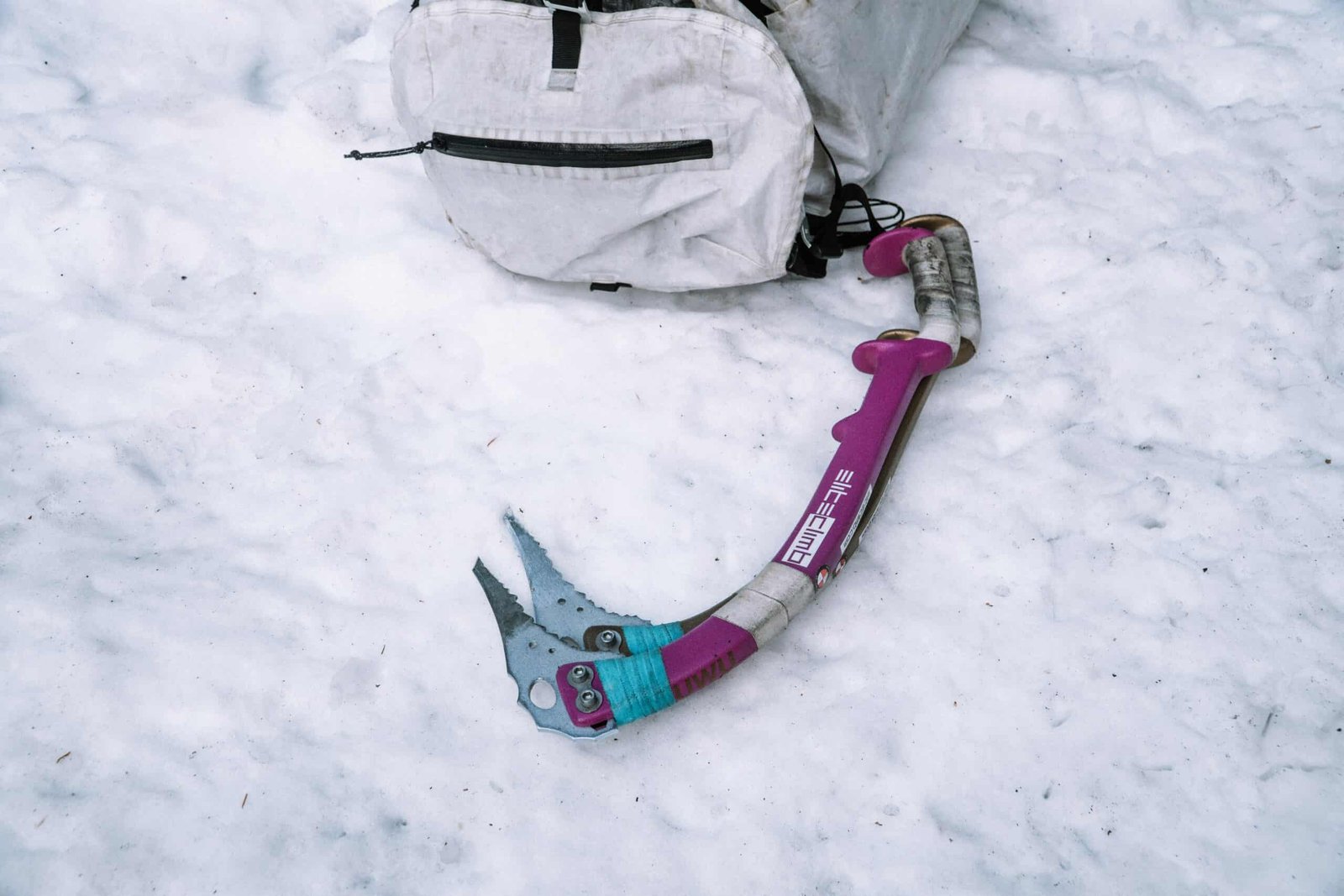
The snow turns from soft to glazed somewhere above the last switchback, and that is where mountaineering crampons and ice axes stop being optional. Crampons hold the slope. An axe stops you when they do not.
This is the point where winter walking becomes something else. Microspikes handle a frozen trail, and neither they nor any traction device will hold on steep snow or ice.
Our roundup of ice traction cleats for hiking covers the tier below this one, and snowshoes against microspikes covers the choice before that.
Quick Verdict
A ten-point strap-on crampon and a walking ice axe cover general mountaineering and glacier travel for most people. Step up to twelve-point step-in crampons only if you have boots rated for them. The axe length matters more than the brand, and a shaft that is too long is worse than one slightly short.
Key Takeaways
- Crampon binding type is dictated by your boot, not by preference.
- Steel holds on ice; aluminum saves weight and wears fast on rock.
- A walking axe and a technical tool are different implements for different ground.
- Neither item is useful without practising self-arrest before you need it.
- Flexible boots and rigid crampons come apart under load.
- Point protectors save your pack, your hands and everything inside.
How We Picked
We sorted by the ground each item is built for, because that is the decision that carries consequences here. Walking terrain, glacier travel and steep ice ask for different hardware.
Then we weighted boot compatibility, since a crampon that does not stay attached is worse than no crampon at all.
We have not climbed on these or load-rated them ourselves, so nothing here reflects testing we carried out. This is also gear where instruction matters as much as the purchase, and a guide or a course is the right place for that rather than a buying guide.
1. Ten-Point Strap-On Crampons, Best Overall
Why It Stands Out
A ten-point steel crampon with a strap binding fits almost any stiff boot and handles snow slopes, frozen trails and easy glacier ground. The strap system is forgiving about welts, which matters because most hiking boots have none.
Ten points also walk more naturally than twelve, since there is no pair of forward-angled front points catching on every step.
Worth Knowing
Straps take longer to fit in the cold than step-in bails, and they loosen if you rush them. Check them again after the first few minutes of walking.
Boot stiffness is still the limiting factor, and waterproof hiking boots vary enormously in how much they flex.
This suits general mountaineering and anyone without welted boots. Skip it for steep ice. Best for: the widest range of boots and terrain.
2. Twelve-Point Step-In Crampons, Best for Steep Ground
Why It Stands Out
Forward-angled front points let you kick into hard snow and ice and stand on your toes, which is what steep ground requires. Step-in bails clamp to a welted boot in seconds and hold without adjustment.
A rigid connection also transmits your weight precisely, so small placements hold.
Worth Knowing
These need boots with a front and heel welt, and a hybrid binding only solves half of that. Fitting them to a flexible boot is how a crampon ends up in the snow behind you.
Front points also snag on rock and on your own gaiters, which is a real nuisance on mixed ground. Hiking gaiters take a beating here.
This suits welted mountaineering boots and steep snow or ice. Skip it with flexible footwear. Best for: standing on front points.
3. Aluminum Crampons, Best for Weight
Why It Stands Out
Aluminum cuts a noticeable amount of weight off each foot, which matters on long approaches where the crampons spend most of the day on the pack. For spring snow and non-technical glacier travel they hold perfectly well.
Ski mountaineers and anyone counting grams on a big day gravitate to these for good reason.
Worth Knowing
Aluminum points blunt quickly on rock and do not bite hard ice the way steel does. Treat them as snow crampons rather than general-purpose ones.
A mixed route will ruin a set in a single outing.
This suits snow travel and long approaches. Skip it for ice or rocky ground. Best for: the lightest option that still works on snow.
4. A Walking Ice Axe, Best First Axe
Why It Stands Out
A straight-shafted walking axe is a third point of contact on the way up and a brake if you slip, which is the pair of jobs most people actually need. The classic design has barely changed because it does both well.
It also doubles as an anchor, a probe and a step cutter, none of which a trekking pole manages.
Worth Knowing
Length is the specification people get wrong, and an axe too long is awkward to arrest with and useless on anything steep. The shaft should reach roughly your ankle when held at your side.
Owning one teaches you nothing. Self-arrest is a skill that needs rehearsing on a safe slope, and cold weather hiking gear covers the rest of what goes with it.
This suits glacier travel, snow slopes and winter hill walking. Skip it for steep ice. Best for: one axe that covers general mountain ground.
5. A Technical Ice Tool, Best for Vertical Ice
Why It Stands Out
A curved shaft and an aggressive pick clear bulges and hook placements that a straight axe cannot reach. On steep ice these are the only thing that works, and they come in pairs.
Grip rests and a pommel let you hang off the tool rather than gripping it closed-handed.
Worth Knowing
A curved tool is poor at self-arrest and awkward to walk with, so it does not replace a walking axe. Most people who climb ice carry both on different days.
Picks wear and are replaceable, which is worth checking before buying a discontinued model.
This suits waterfall ice and steep mixed climbing. Skip it as a first or only axe. Best for: ground too steep for a walking axe.
6. Point Protectors and a Crampon Bag, Best Protection
Why It Stands Out
Twenty sharpened steel points loose in a pack will go through a jacket, a sleeping bag and a hydration bladder. Rubber point covers and a reinforced bag stop that for very little money.
A bag also keeps the melt and grit off everything else you are carrying.
Worth Knowing
Covers come off inside a pack unless they clip or stretch properly, so check the fit on your own points. A spike guard for the axe matters just as much.
Storing crampons wet is how they rust at the hinges.
This suits anyone who carries crampons rather than wears them all day. Skip nothing here. Best for: keeping the points away from your gear.
Crampons and Axes at a Glance
| Item | Terrain | Boot Needed | Material |
|---|---|---|---|
| Ten-point strap-on | Snow, frozen trail, easy glacier | Any stiff boot | Steel |
| Twelve-point step-in | Steep snow and ice | Welted | Steel |
| Aluminum crampons | Spring snow, approaches | Stiff boot | Aluminum |
| Walking ice axe | Snow slopes, glacier | Not applicable | Steel head |
| Technical ice tool | Vertical ice, mixed | Welted | Steel head |
| Protectors and bag | Transport | Not applicable | Rubber, fabric |
How to Choose Crampons and an Ice Axe
Start from the boot, not the crampon
Binding type is decided by whether your boots have welts and how much the sole flexes, and no amount of adjustment fixes a mismatch. Take the boots to the shop or check the stated compatibility before ordering.
Match point count to the angle
Ten points walk better and cover most ground, and twelve exist for standing on steep ice. More points is not an upgrade if the slope never gets steep.
Get the axe length right
Held at your side, the spike should sit around ankle height, and shorter suits steeper ground. People buy long axes because they look like walking sticks, and then cannot arrest with them.
Budget for the conditions, not the kit
Winter mountain days need layers, eye protection and a plan as much as hardware. Base layers for winter hiking and winter goggles and eye protection cover two of those.
Crampons Against Traction Devices
Traction devices handle flat and frozen
Microspikes and coil cleats grip a packed trail or an icy sidewalk and weigh almost nothing, which is why they live in a day pack all winter. They have short points and a stretchy harness, and neither holds on a slope.
Crampons handle angle
Longer points and a rigid frame let you edge and kick on terrain where a fall would keep going, which is the whole distinction. Working out which of the two a given day calls for is the real skill, and how cold is too cold to hike covers the conditions side of that call.
Common Mistakes to Avoid
Fitting step-ins to flexible boots
A soft sole flexes out of a rigid bail under load, usually at the worst moment. Strap bindings exist precisely for boots without welts.
Buying the axe before learning to use it
Self-arrest is a trained reflex and reading about it does not install it. Practice on a safe runout slope before the day you need it.
Treating aluminum as general purpose
Light crampons on hard ice or rock blunt fast and grip poorly. Keep them for the snow they were designed for.
Carrying them without protection
Unsheathed points shred packs and anything in them, including a hydration reservoir on a cold day. Poles strapped alongside them get chewed up the same way.
What Else the Day Needs
Flotation when the snow is deep
Crampons are useless in soft deep snow, where you want surface area instead. Snowshoes for winter hiking cover that, and the flotation calculator sizes them.
Avalanche equipment where it applies
Steep snow that holds crampons is often snow that slides. Carrying avalanche safety gear and knowing how to use it belongs with this tier of terrain.
A rope and the knowledge to use it
Glacier travel means crevasse rescue, which is a skill set rather than a purchase. No buying guide substitutes for instruction here.
Recommended Reading
Worth reading next: thermal insoles and boot warmers, since standing still on snow in stiff boots is how feet get cold.
Crampon and Ice Axe FAQ
What are the best mountaineering crampons and ice axes for a beginner
A ten-point steel strap-on crampon and a straight-shafted walking axe cover general mountaineering and glacier travel, and they fit the widest range of boots. Twelve-point step-ins and technical tools are for steep ice and need welted footwear.
Can I use crampons with regular hiking boots
Sometimes, with strap bindings and a boot stiff enough not to flex much underfoot. A soft trail boot will not hold a crampon reliably whatever the binding.
How long should my ice axe be
Held by the head at your side, the spike should hang around ankle height. Shorter suits steeper terrain, and too long makes self-arrest awkward.
Are microspikes the same as crampons
No. Microspikes have short points on an elastic harness for flat frozen ground, while crampons have long points on a rigid frame for slopes. Using the first where the second is needed is a common and serious error.
Steel or aluminum
Steel for anything involving ice or rock, aluminum only for snow where weight is the priority. Aluminum points dull quickly and bite hard ice poorly.
Do I need two ice tools
Only for steep ice climbing, where tools are used in pairs. General mountaineering wants one walking axe, and a pair of curved tools is poor at the jobs a walking axe does.
How do I stop crampons balling up with snow
Anti-balling plates fitted under the frame shed wet snow that would otherwise pack into a slick platform. Most modern crampons include them, and older ones can usually be retrofitted.
How should I store them between seasons
Dry them fully, check the hinges and bindings for corrosion, and keep the points covered. A sharpening file restores edges, and hand filing is preferred over a grinder because heat ruins the temper.
