
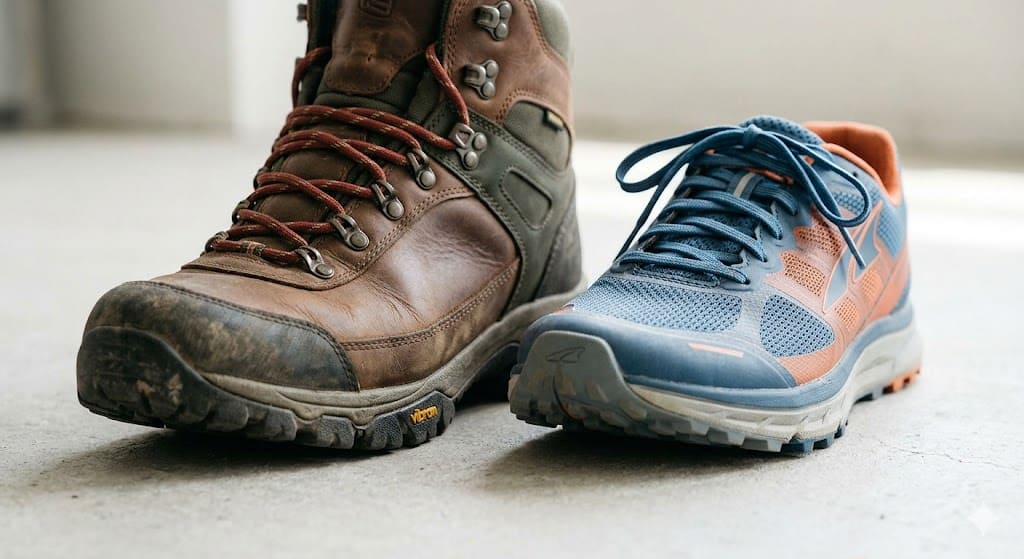
The hiking footwear debate has never been more contested than it is right now. For 50 years, the consensus was clear, leather boots, ankle support, heavy construction. Then ultralight backpackers started finishing thru-hikes in trail runners, and the consensus cracked. Now you will find trail runners at the starting line of the Appalachian Trail alongside full leather boots, and hikers in both camps who will argue passionately for their choice as the objectively correct one.
They are both right. And they are both wrong. The honest answer is that hiking boots and trail runners solve different problems, and the right choice depends entirely on what problem you are actually trying to solve on the specific terrain you actually hike.
For hikers just starting with trail footwear decisions, our guide to the best hiking boots for beginners covers the full range of boot options with specific recommendations for new hikers. Readers leaning toward trail runners should check our best trail running shoes for beginners guide for the top options at every price point. And for hikers whose primary concern is wet trail conditions, our best waterproof hiking boots for wet trails guide covers waterproofing options across both boot and trail runner formats.
What Each Option Actually Is
Hiking boots are structured footwear with stiff midsoles, high ankle collars, and thick lugged outsoles. The stiffness that defines them serves two functions: ankle support that resists lateral twist on uneven terrain, and underfoot protection that prevents sharp terrain from transmitting through the sole to the foot. Traditional hiking boots were leather, heavy, and required a break-in period measured in miles. Modern hiking boots use synthetic materials and advanced cushioning to reduce weight and break-in time while maintaining the structural support that defines the category.
Trail runners are running shoes with outsoles modified for trail use, added lug depth for traction on soft and loose terrain, reinforced uppers for brush and debris contact, and rock plates in some models to protect against sharp terrain contact. They are lighter, more flexible, and faster-drying than hiking boots. They do not provide meaningful ankle support, the low ankle collar that makes them lightweight and flexible also leaves the ankle joint without the lateral support structure that hiking boots provide.
Hiking Boots vs Trail Runners: The Direct Comparison
Ankle support
Hiking boots win on ankle support, this is the most significant functional difference between the two categories. The high ankle collar of a hiking boot resists lateral ankle twist on uneven terrain, loose scree, and technical scrambling where the ankle joint bears lateral loads that the surrounding muscles cannot react to quickly enough to prevent a twist. The protection is not absolute, hiking boots do not prevent every ankle injury, but they reduce the frequency of ankle roll events on terrain where lateral instability is a regular occurrence.
Trail runners provide no meaningful ankle support. The low collar does not resist lateral twist in any significant way. Experienced trail runners and hikers develop ankle strength and proprioception that partially compensates, but the compensation is skill-based, not structural, and takes time to develop. New hikers and hikers with weak or previously injured ankles on technical terrain face meaningfully more ankle injury risk in trail runners than in hiking boots on the same terrain.
Weight and fatigue
Trail runners win on weight by a significant margin. A typical hiking boot weighs 2.5 to 3.5 pounds per pair. A typical pair of trail runners weighs 1.5 to 2.5 pounds per pair. The weight difference of 1 to 2 pounds per pair sounds modest. Over a 10-mile day, each foot lifts and places down approximately 10,000 times, the cumulative fatigue difference of carrying an additional pound per foot through 10,000 foot strikes is substantial. Ultralight hikers who have switched from boots to trail runners consistently report significantly less leg fatigue at the end of long days.
Protection on technical terrain
Hiking boots win in terrain protection. The stiff midsole of a hiking boot prevents sharp rocks from transmitting point pressure through the sole to the foot, a protection that becomes meaningful over the course of a rocky technical day. The reinforced toe cap protects against the stub contact that technical terrain produces. The thick lugged outsole provides traction on a wider range of terrain types than the trail runner outsole, optimized for packed dirt and light rock.
Drying time when wet
Trail runners win on drying time, significantly. A soaked hiking boot takes 24 to 48 hours to dry completely, which matters for multi-day trips where the boot needs to be wearable the next morning. A soaked trail runner dries in 4 to 8 hours in most conditions. For multi-day trips with stream crossings or sustained rain, the drying time difference determines whether your footwear is ready for the next day or requires starting in wet boots, a comfort and blister risk difference that experienced multi-day hikers take seriously.
Breaking in
Trail runners win on immediate comfort, they require no meaningful break-in period. Hiking boots, particularly stiffer leather alternatives, require 20 to 50 miles of use before the boot conforms to the foot adequately and hot spots resolve. New hiking boots on a long first outing produce blisters at the contact points that have not yet softened. Trail runners worn for the first time on a trail feel similar to wearing them around the neighborhood, no significant adaptation required.
Who Should Choose Hiking Boots
Hiking boots are the right choice if:
- You hike technical terrain with loose scree, significant boulder hopping, and sustained lateral instability risk
- You carry heavy pack loads where the pack weight transferred to the feet increases ankle twist risk significantly
- You have weak ankles, previously injured ankles, or reduced proprioception that makes ankle support a genuine injury prevention priority
- You hike in sustained wet conditions where the waterproof membrane of a Gore-Tex boot provides all-day dry feet that trail runners cannot match
- You are a new hiker who has not yet developed the trail-specific ankle strength and proprioception that experienced trail runners rely on
Best hiking boots option:
Who Should Choose Trail Runners
Trail runners are the right choice if:
- You hike on established trails with moderate terrain, where lateral instability risk is low
- You prioritize reducing leg fatigue on long days, where pack weight and footwear weight add up
- You hike fast and light, where the agility and ground feel of trail runners improve your trail experience
- You are an experienced hiker with strong, trail-conditioned ankles and good proprioception
- You do multi-day trips with frequent stream crossings where drying time matters more than waterproofing
- You find the break-in requirement of hiking boots a barrier to comfortable hiking from the first outing
Best trail runners option:
The Verdict
The consensus among experienced hikers has shifted meaningfully toward trail runners for established trail hiking and maintained the boot recommendation for technical and off-trail terrain. That shift reflects real-world evidence, the foot fatigue reduction and comfort advantages of trail runners on most established trails outweigh the ankle support advantage of boots for hikers with adequately conditioned ankles on non-technical terrain. Hikers curious about faster miles can start with making the move to running trails and build from there.
For new hikers who have not yet built trail-specific ankle strength, hiking boots are the safer starting choice. The ankle support provides a margin of error during the ankle conditioning period that trail runners do not. For experienced hikers on established trails, trail runners deliver a more comfortable, less fatiguing day in most conditions.
The honest middle ground for most hikers is mid-cut trail running shoes or lightweight mid-cut hiking shoes, higher ankle collar than a pure trail runner, lighter and more flexible than a full hiking boot, and adequate for the vast majority of three-season established trail hiking that most people actually do.
Frequently Asked Questions: Hiking Boots vs Trail Runners
Are hiking boots or trail runners better for hiking?
Trail runners are better for most established trail hiking, where the weight and fatigue reduction benefits outweigh the ankle support advantage of boots on non-technical terrain with conditioned hikers. Hiking boots are better for technical terrain with significant lateral instability risk, heavy pack loads, sustained wet conditions, and new hikers who have not yet developed trail-specific ankle strength.
Do trail runners provide enough ankle support for hiking?
Trail runners provide no meaningful ankle support, the low collar does not resist lateral twist. Whether that is adequate depends on the terrain, the pack weight, and the hiker’s ankle strength and proprioception. Experienced hikers with strong conditioned ankles on established moderate terrain manage adequately in trail runners. New hikers, hikers with weak or previously injured ankles, and hikers on technical terrain with significant lateral instability risk benefit from the structural ankle support of hiking boots.
Can I use trail running shoes for backpacking?
Yes, many experienced ultralight backpackers complete multi-day and thru-hike routes in trail runners. The critical variables are pack weight and terrain. Heavy pack loads increase ankle twist risk in trail runners because the additional weight amplifies the force at the ankle joint during lateral instability events. Technical off-trail terrain with sustained scrambling demands the lateral support that trail runners do not provide. For established trail backpacking with moderate pack weights and trail-conditioned ankles, trail runners are a legitimate choice that reduces overall carry weight meaningfully.
How do I choose between hiking boots and trail runners as a beginner?
For new hikers starting on established trails with moderate terrain and day packs, trail runners or lightweight mid-cut hiking shoes are the more comfortable and immediately wearable starting choice, no break-in required, less leg fatigue on first long days. For new hikers planning to tackle technical terrain, carry heavy packs, or hike in sustained wet conditions, starting with mid-cut hiking boots provides the ankle support and protection margin that matters more before ankle conditioning develops. Our best hiking boots for beginners guide covers the best beginner-appropriate options in both categories.
