
The first time you try to thread a worm onto a barbed hook, the process feels less like fishing and more like a small ethical crisis. The worm squirms. The hook is sharper than expected. You’re not entirely sure which end of the worm goes where.
Baiting a hook is genuinely simple once you’ve done it a few times. The technique varies by bait type, the size of fish you’re after, and how active the bait needs to look in the water. This guide covers worms (the universal beginner bait), minnows (more effective on bigger fish), and artificial baits for anglers who prefer not to handle live bait at all.
None of these methods are difficult. The squeamishness goes away faster than expected. The fish don’t share it. For the setup that comes before baiting (assembling rod and reel, spooling line, knot tying), see our guides on how to set up a fishing rod and reel and how to tie a fishing knot.
Key Takeaways
- For worms, thread through multiple times to keep the worm secure but leave the tail free to wiggle in the water.
- For minnows, hook through the lips (most active swimming) or through the back (longer-lasting but less active).
- Match hook size to bait size. A worm needs a smaller hook than a minnow; oversized hooks discourage fish from biting.
- Artificial baits are tied directly to the line with a fishing knot; no threading required.
Match the Hook to the Bait
Hook size matters more than most beginners realize. A hook too large for the bait will be visible to fish and look unnatural. A hook too small won’t have enough exposed point to set into the fish’s mouth properly.
Hook sizes are numbered counterintuitively: smaller numbers mean larger hooks (for sizes 1 and up), while larger numbers mean smaller hooks (sizes 2, 4, 6, etc.). A size 6 hook is larger than a size 12 hook. Above size 1, sizes are written with a slash and zero (1/0, 2/0, 3/0, etc.) and larger numbers mean larger hooks again.
General guidelines for common situations:
- Small worms or bait pieces for panfish (bluegill, crappie): size 8 to size 12 hooks
- Whole nightcrawlers for bass or catfish: size 1 to 2/0 hooks
- Live minnows for bass: size 1/0 to 3/0 hooks depending on minnow size
- Salmon eggs or small baits: size 8 to size 14 hooks
Baiting With Worms (Nightcrawlers and Red Wigglers)
Worms are the universal beginner bait because they catch almost every species of freshwater fish and they’re available at every bait shop and many gas stations near water.
The thread-through method
Pick up the worm with one hand. Push the hook point through the worm’s body near one end, then run the worm up the shank of the hook (the straight part below the curve) by threading it back and forth onto the hook. The worm should cover most of the hook shank.
Leave several inches of the worm hanging off the hook bend as a tail. This tail wiggles in the water and attracts fish. A fully threaded worm with no tail catches less than a worm with movement remaining.
The simpler hook-once method
For panfish and smaller species, you can simply hook the worm once through the body near one end. The worm hangs from the hook and wiggles freely. This catches well but the worm comes off the hook easily; expect to rebait often.
The half-worm method
For really small fish or to make worms last longer, break a nightcrawler in half. Half a worm is easier to fit on a small hook and produces less wasted bait. The half-worm twitches just as effectively as a whole worm.
Baiting With Minnows
Live minnows attract larger fish that don’t get excited about worms: bass, walleye, pike, and larger catfish. Minnows are more expensive than worms, harder to keep alive between trips, but more effective for specific targets.
Lip hooking (most active swimming)
Pass the hook through both lips of the minnow, entering through the bottom lip and exiting through the top lip. The minnow can still swim and breathe, which makes it look natural to predator fish.
Lip hooking is the standard for casting and retrieving live minnows. The minnow stays on the hook well during the cast and swims actively in the water. It also wears out the minnow faster than other hooking methods; replace with a fresh minnow when activity slows.
Back hooking (longer lasting)
Pass the hook through the back of the minnow, just behind the dorsal fin (the fin on the top). Avoid the spine; you want the hook through muscle tissue, not bone. A back-hooked minnow stays alive and swimming for an extended period.
Back hooking works well for still fishing (line in the water without active retrieval) where the minnow’s movement attracts fish over time. Less effective for casting because the minnow can be thrown off the hook during the cast.
Tail hooking (alternative)
Pass the hook through the muscle at the base of the tail. The minnow swims forward away from the hook, creating an erratic motion that some fish find irresistible. The minnow tires quickly from this hooking, so use it for short fishing sessions or quick casts.
Baiting With Other Live and Dead Baits
Crickets and grasshoppers: thread through the back of the body (behind the head, before the legs). The insect stays on the hook and twitches. Effective on panfish and trout.
Leeches: thread through the body once, near the smaller end (the head end). Leeches are exceptional bait for walleye and bass but require warm temperatures to perform well.
Cut bait: pieces of fish flesh cut from a previously caught fish. Hook through the skin side, leaving the meat side exposed. Effective on catfish, larger bass, and saltwater species.
Salmon eggs (single or cluster): thread a single egg onto a small hook, or use a treble hook to grab a cluster of eggs. Specialized for trout and salmon.
Dough balls: form a small ball around the hook with the fingers, completely covering the hook. Used for carp and some catfish.
Baiting With Artificial Baits
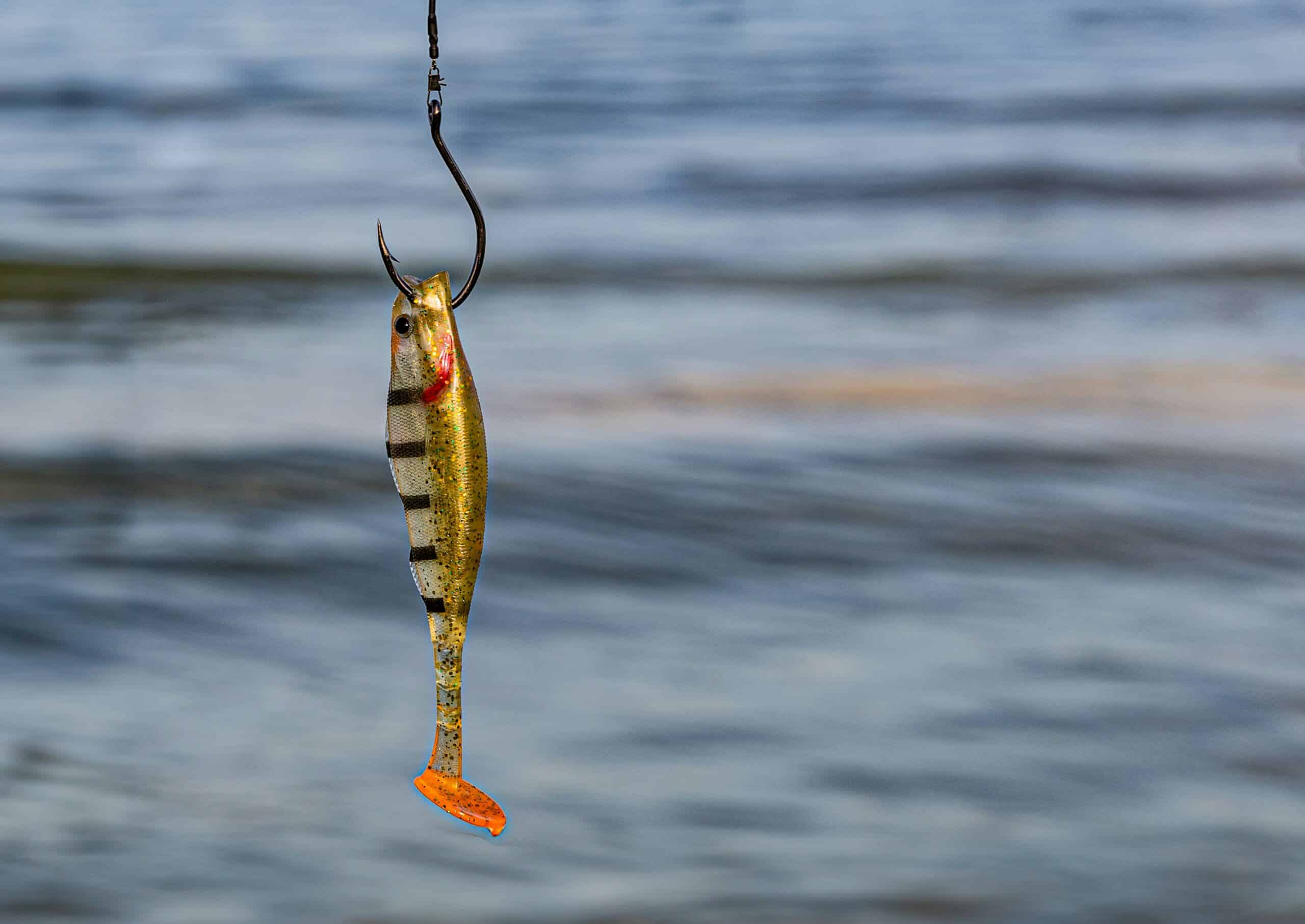
Artificial baits (lures, jigs, soft plastics) skip the bait threading entirely. The bait is built around the hook or tied directly to the line.
Lures and jigs
Most lures and jigs come with the hook already integrated into the lure body. Tie the line to the eye of the lure with a standard fishing knot. The improved clinch knot is the beginner standard; see how to tie a fishing knot for the step-by-step.
Soft plastic worms
Soft plastic worms (popularized for bass fishing) thread onto a special weighted hook. Push the hook point into the head of the worm, slide the worm up the hook shank, then push the point through the worm body and back out so it sits on top of the worm. Several specific rigging techniques exist (Texas rig, Carolina rig, wacky rig); each is a variation on this basic threading.
Why artificial baits are popular
Artificial baits don’t require storage, refrigeration, or handling live creatures. They last for many fish before wearing out. They can be matched to specific water conditions and target species in ways live bait can’t. The trade-off is that artificial bait requires more technique to make it look like live prey; live bait is naturally moving and convincing.
For specific lure recommendations by species, see our coverage of the best fishing lures for bass and the best trout fishing lures. For the technique that follows once the bait is on the hook (casting and setting the hook), see how to cast a fishing rod and how to set the hook when fishing.
Safety When Handling Hooks
The hook point is sharp. Most beginner injuries come from a worm slipping at the wrong moment and the hook ending up in a finger.
Hold the hook with the point facing away from your hand at all times. Use your dominant hand to control the hook and your non-dominant hand to hold the bait. Move the bait onto the hook, not the hook into the bait.
If a hook does end up in a finger, don’t pull it backward (the barb will tear). Push the hook through the skin in the direction it was traveling so the point and barb exit on the other side; cut the barb off with wire cutters; then back the hook out the way it went in. For deep hooks, hooks in sensitive areas (face, eye, near major vessels), or hooks in children, go to urgent care or the emergency room.
How Much Bait to Carry
For worms: a single container of nightcrawlers from the bait shop typically lasts a half-day to full-day of fishing for one angler. Bring two containers if fishing all day or if multiple people are fishing.
For minnows: a dozen minnows is the standard small purchase. Buy more if expecting heavy action or a long day.
For artificial bait: bring a variety of lure types and colors. Match what’s working on the day. Fish preferences change with weather, water clarity, and time of day.
Keep live bait alive: worms need cool moist conditions (a small cooler with a damp cloth works); minnows need aerated water (a small bait bucket with battery aerator). For organizing the hooks, weights, and other components alongside the bait, see the best fishing tackle boxes for beginners and the best fishing pliers and tools for safe hook removal. For shore fishing specifically (where most beginners learn), see how to fish from shore.
Frequently Asked Questions
Does it hurt the worm to be hooked? The biological evidence on whether worms feel pain in the way mammals do is mixed. Some anglers find this question troubling and switch to artificial baits to avoid it. Others consider it part of fishing. The choice is personal.
How do I keep worms alive on a hot day? Keep them cool and moist. A small cooler with a damp cloth (not soaking wet) works well. Avoid direct sunlight on the bait container. Replace bait when worms become sluggish or die.
What’s the difference between nightcrawlers and red wigglers? Nightcrawlers are larger worms typically 4 to 8 inches long; red wigglers are smaller worms (1 to 3 inches). Nightcrawlers catch larger fish; red wigglers work well for panfish and other smaller species.
Can I use bread as fishing bait? Yes, for some species. Bread works for carp, catfish, and bluegill. Form a small dough ball around the hook and cast. Bread baits don’t last long in the water and need frequent replacement.
How do I bait a treble hook? Treble hooks (three hooks together) work best with cluster baits like salmon eggs or with cut bait. Thread the bait onto one or more of the three hooks. The other hooks remain exposed for fish-hooking.
Should I wash my hands after handling bait? Yes, especially before eating. Live bait can carry bacteria, and worm bedding contains soil microorganisms. Hand-wash with soap when you leave the water.
Is artificial bait as effective as live bait? Often yes, sometimes more effective. Skilled anglers using artificial lures match the specific conditions and target species precisely. Live bait is more forgiving for beginners but doesn’t always outperform artificial.
Can I bring the same bait on multiple trips? Worms can survive several days in proper storage. Minnows have shorter lifespan and rarely survive transport between trips. Artificial bait lasts indefinitely.
