
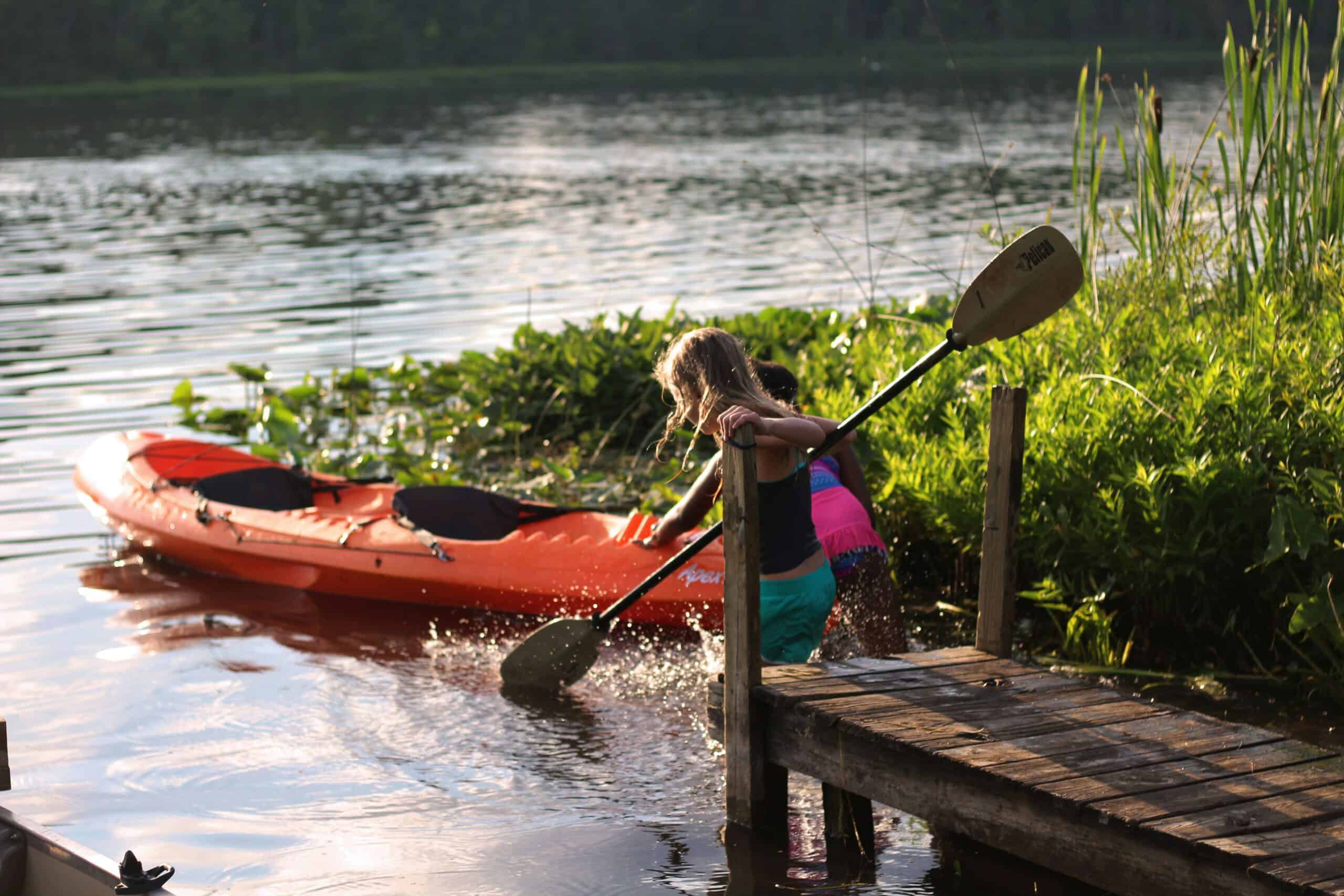
To launch and land a kayak, keep the hull parallel to shore, straddle the cockpit, brace with the paddle, and sit before lifting your feet in. Knowing how to launch and land a kayak is mostly a question of balance and sequence. The shoreline, the water, and the wind change the details every time.
Three settings cover nearly every trip: a sloped boat ramp, a sandy or gravel shore, and a fixed dock. Each one asks for a slightly different entry, though all three reward the same low, patient movement. Paddlers coming from open boats notice this fast, because the difference between a kayak and a canoe starts with how low you sit.
Quick Answer
Float the kayak parallel to the shoreline in shallow water. Straddle the cockpit with one hand on the paddle shaft, which rests behind the seat and out onto the bank. Drop your weight low, sit down, then swing your feet in one at a time.
Key Takeaways
- Keep the hull parallel to the shore or dock, never pointed bow first into it.
- Lower your center of gravity before you move your feet anywhere.
- Use the paddle as an outrigger brace, laid across the deck with one blade on solid ground.
- Match the entry to the setting, since ramps, beaches, and docks each behave differently.
- In surf or wind, come in at an angle and step out on the upwind side.
Step by step: how to launch and land a kayak
The sequence below works on nearly any shoreline. Learn it in calm, shallow water first. Once the order feels automatic, harder launch sites stop feeling risky.
- Set the kayak in water deep enough that it floats free but stays within arm’s reach.
- Turn the hull parallel to the shoreline, dock, or ramp edge.
- Lay the paddle across the deck just behind the cockpit, with one blade resting on solid ground.
- Grip the paddle shaft and the cockpit rim together in your shore-side hand.
- Straddle the boat with one foot on each side, knees soft and hips low.
- Sit down on the back of the seat while your weight stays over the braced paddle.
- Slide your feet in one at a time, then settle your hips fully into the seat.
- Free the paddle, push off gently, and take a short stroke to clear the shallows.
- To land, read the shore first, then approach parallel and slow the boat with a light back stroke.
- Reset the paddle brace, bring your feet out first, and stand only once both feet are planted.
Launching and landing at a sloped boat ramp
A boat ramp gives firm footing and an easy slope, but the surface stays slick almost all the time. Algae and river slime coat the part that sits below the waterline. Plant your feet carefully before you trust them with your weight.
Walk the kayak down until the hull floats clear of the concrete. Turn it parallel to the water’s edge so it sits alongside the ramp rather than pointing down it. A boat aimed bow first will slide away the moment you shift your weight.
Set the paddle across the deck behind the cockpit with one blade flat on the ramp. That blade becomes a third point of contact. Straddle the boat, sit, then bring your feet aboard.
Landing on a ramp works in reverse. Glide in parallel and stop the boat with a gentle back stroke before the hull touches. Step out on the uphill side, where the water is shallower and the footing is closer.
Ramps also serve trailers and motorboats. Move the kayak off the concrete as soon as you are out.
How to get in a kayak on a sandy or gravel shore
A soft shoreline forgives more than concrete does, so most paddlers start here. The main trap is grounding the hull. A kayak resting on sand cannot rock under you, and that stiffness makes the boat feel far tippier than it really is.
Slide the boat out until it floats free but still sits within reach. Stand beside the cockpit with the hull parallel to the beach. Straddle it, brace the paddle across the deck with one blade on firm sand, and sit down.
Gravel scratches hulls, especially when a loaded boat gets dragged over it. Carry the kayak to the waterline whenever the weight allows. Load the heavy items after the hull is already floating.
Landing on sand follows the same shape. Come in parallel, let the last of your speed die, and step out on the shore side. Pull the boat up before the wash starts moving it.
Launching and landing from a fixed dock
A fixed dock puts the deck above the kayak, which makes it the hardest of the three. Height turns a small wobble into a real fall. Sequence matters more here than anywhere else.
Sit on the dock edge with the kayak parallel and pressed against the boards. Put both feet into the cockpit first, keeping your heels near the seat. Hold the near cockpit rim with one hand and the dock with the other.
Lower your hips straight down into the seat in one smooth motion. Keep your head over the boat, not over the water. Lean toward the dock, never away from it.
Landing at a dock reverses the order. Bring the kayak alongside, grab the boards, and hold the hull tight against them. Stand only after your weight has moved fully onto the dock.
Why the paddle brace and a low center of gravity keep you upright
A kayak stays stable when your weight sits low and centered over the hull. Standing up inside the cockpit raises that weight, and the boat answers immediately. Almost every entry spill traces back to a body that stood too tall.
The paddle brace fixes this. Laid across the deck behind the cockpit with one blade on solid ground, the paddle works like an outrigger. Press down on the shaft and the hull cannot roll away from you.
Hold the shaft and the cockpit rim together in one hand so both move as a single unit. That grip stops the paddle sliding while you sit. A shaft with a comfortable diameter helps, which is one reason choosing a first paddle deserves real thought.
Posture inside the boat matters just as much. Sit upright with your hips back and your knees pressed lightly outward against the deck. A seat that supports your lower back makes that position easy to hold for hours.
How to land a kayak in small surf or wind
Wind and small surf both push the boat sideways, so a straight bow-first landing rarely works. Come in at a slight angle instead. The angle keeps some steering available while the water still carries you forward.
In small surf, watch the sets from outside the break before committing. Ride in behind a wave rather than on top of one. A broadside hull in breaking water will roll, so keep the bow angled and the paddle ready to brace.
Once the hull grounds, get out quickly and move the boat up the beach. The next wave will lift a light kayak and shove it. A swamped cockpit becomes much heavier to drag.
In wind, step out on the upwind side. The kayak then drifts toward your legs instead of pinning them against the shore. That one choice keeps you in control while your feet find the bottom.
Recommended Reading
Entries and landings go smoother when the rest of the setup is sorted. A vest that fits close to the body stays out of the way during a straddle entry, and a dry bag that seals properly keeps a wet launch from ruining the day. Paddlers who fish handle heavier loads at the waterline, so a hull built for angling changes how these steps feel.
Frequently asked questions about launching and landing a kayak
What is the easiest place to learn how to launch and land a kayak?
A calm sandy shore is the easiest place to learn how to launch and land a kayak. The bottom is soft, the water is shallow, and a stumble costs nothing. Practice the straddle entry there until the sequence feels automatic, then move on to ramps and docks.
Should the kayak point at the shore or sit parallel to it?
Parallel wins in almost every situation. A bow-first boat sits half on land and half in water, so the hull cannot settle and the stern swings free. Parallel keeps the whole hull floating and puts the shoreline within easy reach of your hand and paddle blade.
How do you get into a kayak from a dock without tipping?
Feet first, then hips. Sit on the dock edge, place both feet into the cockpit near the seat, and hold the cockpit rim with one hand. Lower your weight straight down while leaning slightly toward the dock, and settle into the seat before letting go.
What should you do if the kayak grounds on sand or gravel?
Push it back out until it floats before you sit down. A grounded hull cannot rock, and that rigid feeling makes small shifts of weight feel alarming. Grounding also grinds grit into the hull, which wears the material faster than open water ever will.
Which side should you step out on when landing in wind?
Step out on the upwind side every time. The wind then pushes the kayak toward you, so the boat stays within reach while your feet find the bottom. Stepping out downwind lets the hull drift onto your legs or away from you, and both outcomes cost control.
How do you launch a kayak alone?
Solo launches work fine with the paddle brace. Set the boat parallel and floating, lay the paddle behind the cockpit with one blade on firm ground, and hold the shaft and rim together. That single grip replaces a second pair of hands and steadies the hull as you sit.
Why does a low center of gravity matter so much in a kayak?
A kayak is narrow, so stability depends on where your weight sits rather than how wide the boat is. Weight held low stays inside the balance point of the hull. Standing upright in the cockpit lifts that weight above the boat, and the kayak tips to answer it.
