
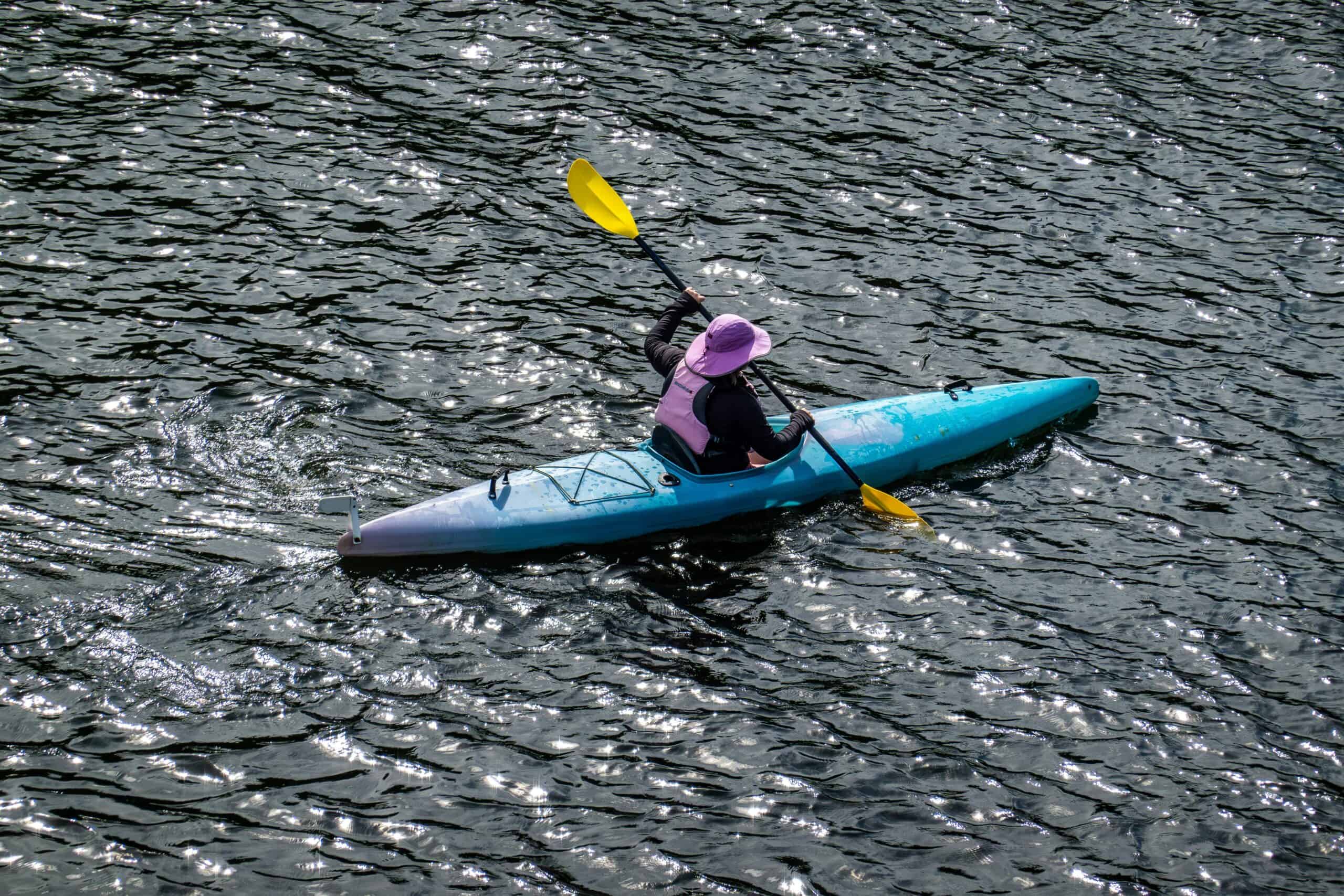
To get back in a kayak after flipping, right the hull, kick hard to slide your chest onto the rear deck, then twist your hips into the seat. Learning how to get back in a kayak after flipping is a matter of technique and timing, not raw strength. A calm paddler with a method beats a strong paddler who thrashes.
The capsize itself is rarely the real problem. Trouble starts when a paddler loses the boat, loses the paddle, or fights the water instead of working with it. Hull shape changes the whole recovery, which is one reason the difference between a kayak and a canoe shows up fast in a swim.
Quick Answer
Exit the cockpit, keep one hand on the boat, and flip the hull upright. Kick your legs to the surface, pull your chest across the rear deck, and rotate onto the seat. Pump or drain the water, settle your grip, and paddle straight for shore.
Key Takeaways
- Leave the cockpit in a controlled wet exit before trying anything else. Panic wastes air and energy.
- Hold the boat. Wind pushes an empty hull faster than most swimmers can chase it.
- Right the hull before climbing. A capsized boat traps water and fights every attempt.
- The heel hook uses leg power, and the cowboy scramble uses momentum. Both beat pulling with the arms alone.
- A sit-on-top drains itself. A sit-inside needs a pump, a sponge, or a shoreline.
- Practice in warm, shallow water where a failed attempt costs nothing.
Step by Step
- Stay tucked and lean forward against the deck. This protects your face and keeps your body compact.
- Find the spray skirt grab loop and pull it forward and up. The skirt peels off the cockpit rim in one motion.
- Push your knees outward and roll out of the cockpit. Let gravity do most of the work.
- Surface beside the hull, never underneath it. Get one hand on a deck line right away.
- Locate the paddle. Tuck it under a deck bungee or hold it against the hull with the same hand.
- Right the boat. Reach across, grip the far edge, and flip the hull away from you so the cockpit clears the surface.
- Move to the side of the boat beside the seat. Face the hull and get both hands on the far edge.
- Kick your legs up until they plane near the surface. Pull your chest onto the deck in one committed move.
- Rotate onto your seat and drop your legs in. Keep your weight low and centered while you settle.
- Pump or bail the water out before you paddle. A swamped boat handles badly and flips again easily.
Why the wet exit comes first
A wet exit is the controlled way to leave an upside down kayak, and it happens before any re-entry attempt. Every recovery starts with a paddler who is out of the boat and breathing. Rushing this step is what turns a small mistake into a bad day.
The instinct after a capsize is to sit up. That instinct fights the boat. Leaning forward instead keeps your body against the deck and your knees free to slide out.
The spray skirt is the one part that can hold a paddler in place. Its grab loop sits at the front of the cockpit rim for exactly this reason. Pull it forward, not sideways, and the skirt releases cleanly.
Staying with the boat and the paddle after a capsize
The boat floats better than the swimmer, so it becomes the priority the moment you surface. It is also the only thing a rescuer can spot from a distance. Letting go of the hull turns a recoverable capsize into a long swim.
Wind and current move an empty kayak quickly. A swimmer in wet clothing moves slowly. That gap opens faster than most paddlers expect, and it does not close.
Hook a wrist or an elbow through a deck line as soon as your head is clear. Keep the paddle in the other hand or under a bungee. A lost paddle turns a solved problem back into an unsolved one.
Visibility matters just as much. A swimmer sits low and disappears between small waves, so sound carries further than any wave of the arm. That is why many paddlers clip a whistle to the vest strap where a wet hand can find it.
Heel hook or cowboy scramble: which re-entry actually works
The heel hook and the cowboy scramble are the two self rescue re-entries most paddlers learn first. Both get a swimmer from the water into the seat. They differ in where the power comes from.
The heel hook uses the legs. Face the boat from the side, reach across the cockpit, and grip the far edge with both hands. Swing your nearest heel up and hook it inside the cockpit rim.
From there, pull with the arms and straighten that hooked leg. Your body rolls up and over the deck rather than climbing it. Rotate your hips onto the seat and drop the second leg in.
The cowboy scramble uses momentum instead. Approach from the stern, kick hard, and belly onto the back deck as your body planes toward the surface. Straddle the deck like a saddle and crawl forward until your seat is under you.
Neither move rewards hesitation. A half committed pull drags the boat over and starts the whole sequence again. Kick first, then pull, and keep your chest low against the deck the entire time.
Righting a flipped sit-inside versus a sit-on-top
The two hull types behave completely differently once they are upside down. A sit-on-top sheds water on its own. A sit-inside holds whatever it scooped on the way over.
Flipping a sit-on-top is simple. Reach across, grip the far edge, and roll the hull toward you. Scupper holes drain the deck while you climb back on.
A sit-inside needs more care. Lift the near edge slightly and flip the hull away from your body so the cockpit breaks the surface and sheds water instead of scooping it. Doing this in one smooth motion keeps a surprising amount of water out.
Draining the water with a bilge pump and float bags
A hand bilge pump is the single most useful piece of gear for emptying a swamped kayak on the water. It clears water while you stay seated and balanced. Nothing else does that job as quickly.
Store the pump where a cold, wet hand can reach it without looking. Under a deck bungee works well. A pump buried in a hatch may as well be at home.
Float bags attack the same problem from the other side. They fill the empty space in the bow and stern so less water can get in. A boat with float bags floats higher, drains faster, and stays easier to control.
Why a life vest changes everything, and why practice matters more
A life vest is what makes every technique on this page possible, because floating without effort is what lets a swimmer think clearly. Treading water burns energy that re-entry needs. A vest removes that cost entirely.
It also holds the small gear that a capsize demands. A whistle, a knife, and a signal device belong on the vest, not in a hatch. Gear you cannot reach while swimming is gear you do not have.
Fit decides whether a vest helps or hinders. A loose vest rides up over the ears and blocks the arm motion a re-entry needs, which is why a properly fitted paddling vest is worth more than a generic one from a rental shed.
Cold water is dangerous, and it makes every step here harder to perform. Formal instruction from a paddling course is worth taking, and it is the fastest way to build these skills correctly. Practice re-entry in warm, shallow water first, on a calm day, with someone watching.
That is the real lesson buried in all of this. A capsize is not the moment to learn the sequence. Repeat it until your body does it without asking your brain for permission.
Recommended Reading
Keeping the contents of your boat dry is a separate problem from keeping yourself in it, and the right dry bags for paddling solve it. For remote water far from help, a personal location beacon is the last link in the chain. Our guide to signaling for help in the backcountry covers what to do when self rescue is not working.
Frequently asked questions
What is the fastest way to learn how to get back in a kayak after flipping?
Go to a warm, shallow, calm spot and flip the boat on purpose. Run the full sequence from wet exit to seated and drained, then repeat it until it feels boring. A short course with an instructor speeds this up, because someone watching corrects small errors immediately.
Should you flip the kayak upright before climbing in?
Yes, always right the hull first. An upside down boat gives you nothing to climb onto and traps water in the cockpit while you struggle. Reach across, grip the far edge, and roll the hull away from your body so the cockpit clears.
What happens to a sit-inside kayak that fills with water?
It sits very low, feels unstable, and rolls under the smallest shift in weight. Water inside the hull sloshes with every movement and pushes the boat over. You can still climb in, and you should, because only a seated paddler can pump.
Is the cowboy scramble harder than the heel hook?
For most paddlers, yes. The cowboy scramble depends on momentum and balance, and a narrow hull punishes any wobble while you straddle the deck. The heel hook uses leg strength and keeps your center of gravity lower, so most paddlers land it reliably after less practice.
How do you keep the paddle from floating away during a capsize?
Grab it as you surface and secure it before doing anything else. Slide the shaft under a deck bungee, or trap it against the hull with the hand holding the deck line. A paddle leash removes the problem, though some paddlers avoid leashes in moving water.
Can you empty a kayak without a bilge pump?
Yes, but emptying a kayak without a pump is slower and messier. A large sponge works for the shallow water around the seat. Otherwise you paddle the swamped boat carefully to shore, lift the bow, and let the cockpit drain, which only works with a shoreline in reach.
Where should a paddler practice a kayak re-entry?
Warm, shallow, sheltered water with a soft bottom is ideal. Standing depth means a failed attempt costs nothing more than a reset and another try. Bring a friend, wear the vest you actually paddle in, and use the boat you take on real trips.
