
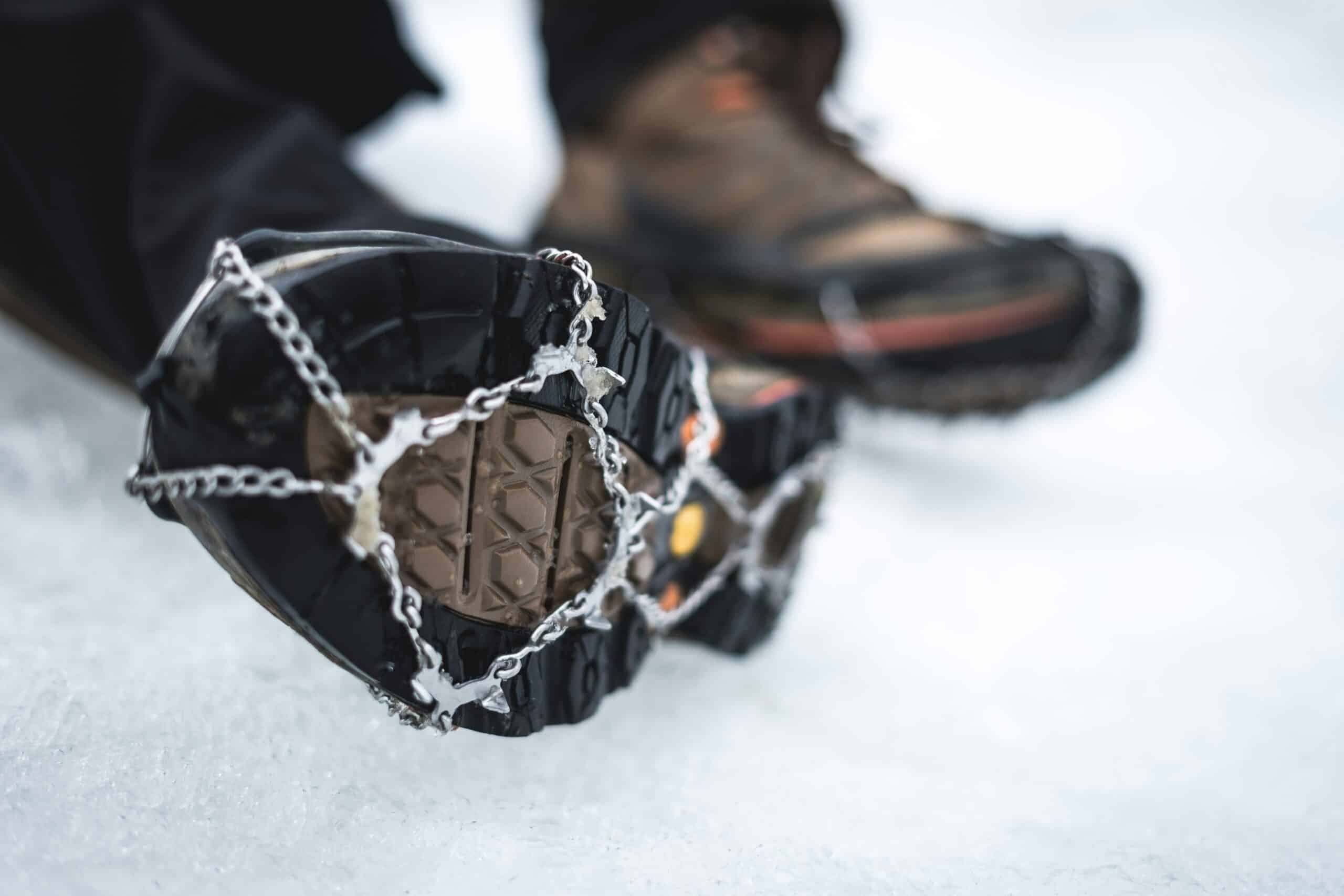
Traction cleats stretch over your boots and put metal between the sole and the ice. The category divides by spike length, and that single dimension decides where a pair works. Short coils grip packed snow on a flat trail. Long steel spikes bite hard ice on a slope. Using the first on the second is how people end up sliding.
None of these are crampons. Real crampons attach rigidly to stiff mountaineering boots and hold on steep ice where a fall is not survivable. Traction devices are for walking, and knowing where the line sits between the two matters more than any spec.
| Type | Spike length | Works on | Fails on |
|---|---|---|---|
| Coil traction | None, wire coils | Packed snow, slush | Hard ice, slopes |
| Rubber studs | Very short | Icy sidewalks | Anything steep |
| Microspikes | Roughly a third of an inch | Packed trails, moderate ice | Steep ice, deep snow |
| Aggressive spikes | Half an inch or more | Hard ice, rolling terrain | Bare rock, indoor floors |
| Heel-only cleats | Short | Level walking | Climbing, descending |
| Crampons | An inch or more | Steep ice with stiff boots | Flexible boots, trail walking |
Key Points
- Spike length determines the terrain, more than brand or price
- Microspikes cover the widest range of winter trail conditions
- Chains and spikes wear fast on bare rock and pavement
- Elastomer harnesses stiffen and tear in deep cold, so check the rating
- A snug fit matters, since a cleat that rotates puts spikes where they do nothing
- Traction devices do not replace crampons on steep ice
Related: snowshoes vs microspikes.
How We Picked
Spike geometry came first. Length, count, and placement across the sole decide whether a device grips on a traverse or only pushing straight ahead. Devices with spikes under the forefoot and the heel outperform those clustered in the middle.
Harness material came second. The elastomer that stretches over a boot is the part that fails, either tearing at a stress point or going rigid in deep cold. Manufacturers stating a low-temperature rating gave us something to compare.
Retention settled the rest. A device that rolls off a toe on a side slope is a hazard rather than an aid. Velcro straps over the instep and heel tabs that actually hold ranked above simple slip-on designs.
1. Microspikes
Why It Stands Out
Short steel spikes on a chain harness cover more winter hiking conditions than anything else in the category. Packed trail, patchy ice, frozen mud, moderate slopes. They pack small, weigh little, and go on over any boot in under a minute.
Worth Knowing
Spikes around a third of an inch bite packed surfaces well and skate on genuinely hard water ice at an angle. They also offer no flotation, so once snow gets deep you are postholing with metal on your feet.
Right for most winter day hiking on trails. Skip it for steep ice or deep unbroken snow.
2. Coil Traction Devices
Why It Stands Out
Steel coils rather than spikes, wrapped across the sole. They grip packed snow and slush well enough, cost less than spiked devices, and cause no damage to floors or vehicle carpets if you forget to take them off.
Worth Knowing
Coils do not penetrate, so on hard ice they slide. The coils also snap after a season or two of regular use, and a broken coil leaves a section of sole with nothing. Treat these as urban and gentle-trail equipment.
Right for icy sidewalks, packed flat trails, and dog walks. Skip it for hills or hard ice.
3. Aggressive Spike Cleats
Why It Stands Out
Longer spikes, often half an inch or more, penetrate hard ice that microspikes skate across. On frozen waterfall trails, rolling ice, and lake edges, the extra length is what holds you on the surface.
Worth Knowing
Long spikes are unpleasant on bare rock, and rock sections wear them fast. They also feel unstable on hardpack, since you stand on spike tips rather than on the sole. Carrying them and switching at the ice is common practice.
Right for hard ice and mixed frozen terrain. Skip it for trails with long rock or dry sections.
4. Rubber Stud Overshoes
Why It Stands Out
Small carbide or steel studs in a rubber overshoe suit commuting, walking a dog, and getting to the car. They slip on over street shoes, pack into a coat pocket, and cost very little.
Worth Knowing
Stud length is minimal, so grip on anything sloped is limited. These are for level surfaces where a fall means a bruise rather than a slide down a hillside. Do not take them on a trail with elevation.
Right for sidewalks, driveways, and errands. Skip it for hiking.
5. The Heel-Only Cleat
Why It Stands Out
A small plate of spikes under the heel only, which is where most slips start on level ground. Minimal, light, and it leaves the forefoot free, which some people prefer for walking on mixed surfaces.
Worth Knowing
No forefoot traction means no grip on a climb, since climbing loads the toe. Descending is worse, because the heel plate can act as a skid. This is a walking aid rather than hiking equipment.
Right for flat winter walking on mixed surfaces. Skip it for any terrain with gradient.
6. The Cold-Rated Harness Set
Why It Stands Out
Elastomer harnesses stiffen as temperature drops, and a harness that goes rigid tears when you stretch it over a boot. Devices with a stated low-temperature rating survive deep cold, which is exactly when you need them.
Worth Knowing
Cold-rated harnesses cost more and are worth it if your winters run cold. Warming the harness inside a jacket before fitting also helps any device, and storing them in a car boot overnight is how people snap them at the trailhead.
Right for deep cold regions and early morning starts. Skip the premium in mild winters.
Fitting and Carrying Them
Fit them at home first
Stretch the harness over the boots you will actually wear, stand on a hard floor, and check nothing rotates. Doing this in a car park at dawn with cold hands is how people set off with a device sitting crooked.
Carry them in a stuff sack
Loose spikes shred a pack liner and puncture a water bladder. A small drawstring bag or a dedicated pouch costs little and prevents a wet pack.
Rinse the salt off
Road salt and coastal air corrode steel spikes and chain quickly. A rinse in fresh water and a dry before storage adds seasons to a set.
Check the harness before each season
Elastomer degrades with UV and cold cycling, and the failure shows as a small tear near a spike plate. Finding it in the garage beats finding it on a slope.
Choosing by Terrain
Packed trail with patchy ice
Microspikes cover this, which is why they dominate winter day hiking. They handle the packed sections, bite the ice patches, and walk acceptably over short rock.
Hard ice on a gradient
Longer spikes, and consider whether the route is beyond a traction device altogether. If a slip would slide rather than stop, the honest answer may be crampons and an axe rather than cleats.
Deep snow
Traction devices do nothing about depth. Snowshoes address that, and many winter routes involve carrying both and switching where the surface changes.
Mixed rock and ice
Shorter spikes tolerate rock better than long ones, and rock wears any of them. Some hikers accept the wear and carry a spare, and others switch devices at the transition.
Traction Devices Versus Crampons
Where the line sits
Traction devices flex with a hiking boot and are built for walking on ice. Crampons are rigid, attach to stiff-soled boots, and are built for climbing ice where a fall does not stop on its own. The gap between them is not gradual.
Choosing correctly
If the terrain would send you sliding rather than dropping you in place, you are past what cleats cover. That is a mountaineering decision rather than a gear purchase, and boot stiffness is part of it, covered in boot selection.
Common Traction Cleat Mistakes to Avoid
Buying coils for hills
Coils grip packed snow and slide on ice at any angle. They are the right tool for a sidewalk and the wrong one for a slope.
Fitting them cold and stiff
A harness left in a freezing car tears when stretched. Warm it inside a jacket for a few minutes before fitting.
Walking long rock sections in long spikes
Rock blunts spikes fast and makes the walking unstable. Take them off for extended dry sections and put them back on at the ice.
Assuming a loose fit is fine
A device that rotates on the boot puts spikes along the edge instead of under the sole. Check the fit standing on a hard surface before the trail, and see the winter gear list for what else to check.
Worth reading next: gaiters keep snow out of the boots your cleats attach to, and layering covers staying warm while moving slowly. For short winter days see headlamps, and for navigation when snow hides the trail, a compass works when tracks do not. Also worth having: waterproof boots, insulated gloves, and a bottle that will not freeze.
Frequently Asked Questions
What is the difference between microspikes and crampons?
Microspikes flex with a hiking boot and have short spikes for walking on ice and packed snow. Crampons are rigid, need stiff mountaineering boots, and are built for climbing steep ice. They cover different terrain rather than different budgets.
Will traction cleats work in deep snow?
No. They address grip rather than depth, and in deep snow you sink regardless of what is on your soles. Snowshoes handle depth, and winter routes often need both.
Can I walk on rock with spikes on?
Short distances, yes, at the cost of blunting the spikes. Long rock sections wear them noticeably and make walking unstable, so taking them off and refitting at the ice is common practice.
Do cleats fit any boot?
Most fit a size range, and a snug fit matters more than the brand. A device that rotates on the boot puts the spikes along the edge rather than under the sole, which is worse than not wearing them.
Why did my traction device break?
Usually the elastomer harness, either torn at a stress point or snapped after being stretched while frozen. Warming the harness before fitting and choosing a cold-rated set both extend the life.
Are microspikes enough for winter hiking?
For most maintained trails in winter, yes. Steep ice, exposed slopes, and routes where a slip would slide rather than stop call for more, and that is a route-planning question rather than a purchase.
Recommended Reading
See our note on planning a hiking route.
